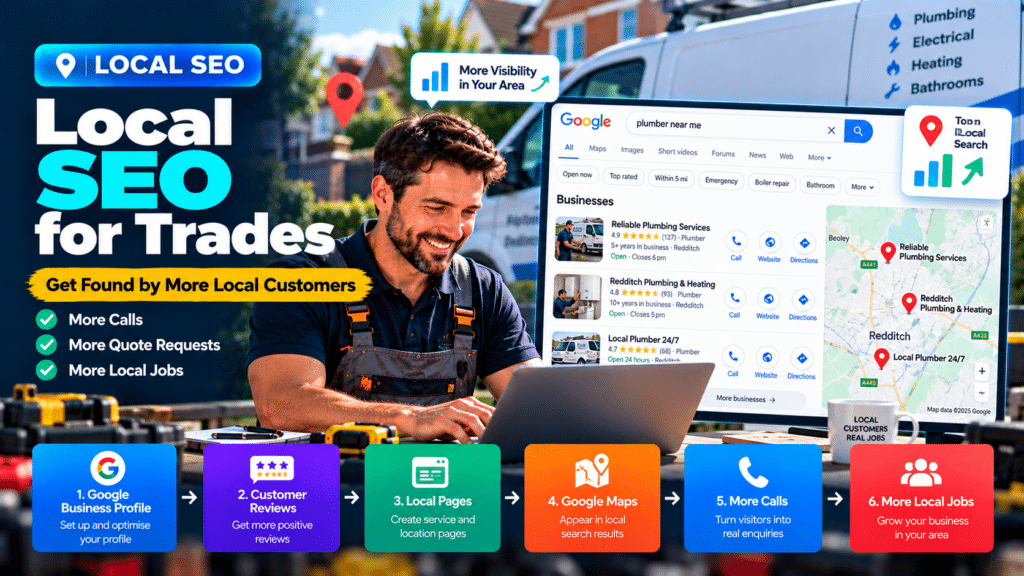
For many trades and service businesses, the most valuable searches are local.
A plumber does not need to rank for every plumbing search in the country.
An electrician usually wants to appear when somebody nearby searches for services such as:
- electrician near me;
- emergency plumber;
- boiler repair;
- EV charger installation;
- local contractor;
- heating engineer;
- bathroom installer.
That is what local SEO for trades is about.
Local SEO is the process of helping a business become more visible when nearby customers search for relevant services.
For plumbers, electricians, HVAC companies, builders, cleaners, landscapers and other local service businesses, this usually involves a combination of:
- Google Business Profile;
- website optimization;
- local service pages;
- reviews;
- business information consistency;
- links and mentions;
- technical SEO;
- useful local content.
This guide explains how the process works and what small trade businesses should prioritize.
What Is Local SEO?
Local SEO is search engine optimization focused on helping businesses appear for searches connected to a geographic area.
Examples include:
plumber in Manchester
electrician near me
boiler repair Birmingham
roofing contractor Dallas
HVAC repair Chicago
The searcher usually wants a nearby business that can provide the service.
Google can show local businesses across regular organic results, Google Maps and local result features.
Google says local ranking is mainly determined by three factors:
- relevance;
- distance;
- prominence (source: Google Support).
How Google Determines Local Rankings
Understanding these three factors helps explain what local SEO can and cannot control.
Relevance
Relevance is how closely the business matches what the searcher wants.
Google recommends providing complete and detailed business information so it can better understand the business and match it to relevant searches (source: Google Support).
For a plumber, that means clearly describing actual services such as:
- emergency plumbing;
- leak repair;
- boiler servicing;
- bathroom plumbing;
- drain repair.
For an electrician, that might include:
- rewiring;
- EV charger installation;
- fault finding;
- electrical inspections;
- consumer unit work.
The clearer the business is about what it does, the easier it is for both users and search engines to understand its relevance.
Distance
Distance refers to how far the business is from the person searching or from the location mentioned in the query (source: Google Support).
This is important because distance is not something you can fully optimize away.
A company based far from a searcher may not appear as prominently as a closer relevant business.
That is why local SEO should focus on the areas the business genuinely serves rather than trying to appear everywhere.
Prominence
Prominence refers to how well known or established the business is.
Google says prominence can be influenced by information it finds across the web, including links, articles and directories, while review count and positive ratings can also contribute to local ranking (source: Google Support).
This is where:
- reviews;
- local citations;
- backlinks;
- brand mentions;
- strong organic rankings
can support local visibility.
Why Local SEO Matters for Trades
Trades businesses often depend heavily on high-intent local searches.
Someone searching:
emergency plumber near me
probably has a more immediate need than someone reading a generic article about plumbing.
That makes local visibility valuable because the searcher may already be close to contacting a business.
Local SEO can support:
- phone calls;
- quote requests;
- booking requests;
- website visits;
- direction requests;
- repeat local brand recognition.
It does not guarantee leads, but it helps improve visibility where local customers are already searching.
Step 1: Set Up and Verify Google Business Profile
Google Business Profile is one of the most important assets for local businesses.
Google recommends claiming and verifying the business so that you can manage how it appears in Search and Maps (source: Google Support).
Your profile should contain accurate information such as:
- business name;
- address or service-area settings;
- phone number;
- website;
- hours;
- category;
- services;
- photos.
Google says complete and accurate business information can improve the likelihood of appearing in relevant local results (source: Google Support).
Choose the Right Primary Category
The primary category should reflect the core business as accurately as possible.
Examples might include:
- Plumber;
- Electrician;
- HVAC Contractor;
- Roofing Contractor;
- Cleaning Service.
Do not choose unrelated categories simply because they seem to have more search volume.
Relevance matters more than trying to appear for everything.
Add Relevant Secondary Categories Carefully
Secondary categories can help describe other genuine services the business provides.
However, avoid adding categories that do not accurately represent the business.
The profile should make the business clearer, not more confusing.
Add Your Services
Where available, list the main services you actually provide.
For example, a plumbing business might include:
- leak repair;
- pipe installation;
- boiler servicing;
- bathroom plumbing.
An electrical company might include:
- EV charger installation;
- rewiring;
- EICR inspections;
- fault finding.
This can help strengthen the profile’s relevance to appropriate searches.
Keep Business Hours Accurate
Google specifically recommends keeping business information up to date, including hours (source: Google Support).
This is especially important for:
- emergency services;
- holiday hours;
- seasonal businesses.
If you advertise 24-hour service, make sure that is genuinely accurate.
Step 2: Make Business Information Consistent
Your core business information should be consistent across the web.
This often includes:
- business name;
- address;
- phone number;
- website.
You may hear this called NAP consistency:
Name, Address, Phone
If one directory has an old phone number and another uses a different business name, that can create confusion for both customers and search systems.
Google sources business information from multiple places, including business owners, public web content, third-party sources and user contributions (source: Google Support).
That makes consistency important.
Step 3: Build a Strong Local Website
Your Google Business Profile should not exist in isolation.
Your website helps explain:
- what you do;
- where you work;
- which services you provide;
- why customers should trust you.
Google may use information from your official website when understanding business information (source: Google Support).
A strong trades website should usually contain:
- homepage;
- service pages;
- About page;
- contact page;
- service-area information;
- customer reviews or testimonials;
- helpful guides.
Create Dedicated Service Pages
Avoid putting every service into one generic page if each service is important enough to deserve its own explanation.
A plumber might create pages for:
- emergency plumbing;
- boiler repair;
- drain services;
- bathroom installations.
An electrician might create pages for:
- EV chargers;
- rewiring;
- inspections;
- consumer units.
Each page should clearly explain:
- the service;
- who it is for;
- common problems;
- how the process works;
- service area;
- how to contact the business.
Create Location Pages Carefully
Location pages can be useful when a business genuinely serves multiple areas.
For example:
Electrician in Redditch
Electrician in Bromsgrove
Electrician in Solihull
But do not create dozens of nearly identical pages that only swap the city name.
A useful location page should contain genuinely relevant information such as:
- services offered in that area;
- actual coverage details;
- local examples;
- response considerations;
- relevant customer questions.
Quality matters more than the number of pages.
Step 4: Optimize Page Titles and Headings
Each important service and location page should have a clear page title.
For example:
Emergency Plumber in Birmingham | ABC Plumbing
or:
EV Charger Installation in Manchester | XYZ Electrical
The main heading should also clearly describe the page.
Avoid vague headings such as:
Welcome
or:
Our Solutions
Specific wording helps both customers and search engines understand what the page is about.
Step 5: Optimize for Mobile Users
Many local searches happen on mobile devices.
A customer looking for an emergency plumber may not be sitting at a desktop computer.
The website should make it easy to:
- call;
- request a quote;
- find service information;
- submit a form;
- check opening hours.
Make phone numbers clickable.
Keep forms short.
Make buttons large enough to use easily.
Step 6: Improve Website Speed
A slow website can create a poor experience.
Trades websites often become heavy because of:
- large images;
- page builders;
- unnecessary scripts;
- too many plugins;
- autoplay video.
Compress images and avoid unnecessary effects.
A visually impressive website is not useful if potential customers leave before it loads.
Step 7: Collect Genuine Customer Reviews
Reviews are important for local businesses.
Google says review count and positive ratings can contribute to prominence and improve local ranking (source: Google Support).
But reviews should be genuine.
A simple review-request workflow might look like:
Job completed
↓
Customer receives thank-you message
↓
Review request sent
You can automate the request, but the review itself should come from the real customer.
Respond to Reviews
Responding to reviews is useful for customer service.
For positive reviews, thank the customer naturally.
For negative reviews:
- stay professional;
- acknowledge the concern;
- avoid arguments;
- move sensitive discussions offline where appropriate.
Do not fill responses with keywords.
Write for the customer.
Step 8: Build Local Citations
A citation is an online mention of your business information.
Common examples include:
- business directories;
- trade directories;
- local chambers;
- industry associations;
- local business listings.
The goal is not to submit the business to hundreds of low-quality directories.
Prioritize:
- reputable;
- relevant;
- local;
- industry-specific
sources.
Make sure the information matches your actual business details.
Step 9: Earn Relevant Local Links
Links can help establish prominence and authority.
Google says prominence can be influenced by web information including links and articles (source: Google Support).
Good local link opportunities might include:
- local suppliers;
- business associations;
- local sponsorships;
- community organizations;
- partner businesses;
- relevant trade organizations.
Avoid buying large quantities of low-quality links.
A few relevant links can be more useful than hundreds of meaningless ones.
Step 10: Publish Useful Local Content
A blog is not mandatory for every trades business.
But useful content can help the website answer customer questions.
Examples include:
For Plumbers
- What to Do When a Pipe Bursts
- How Much Does Boiler Repair Cost?
- Signs You May Have a Hidden Water Leak
For Electricians
- Do I Need a New Consumer Unit?
- How Long Does a Rewire Take?
- What Do I Need Before Installing an EV Charger?
For HVAC
- When Should You Service Your Boiler?
- Why Is My AC Not Cooling?
- Heat Pump Maintenance Checklist
The goal is to answer questions your real customers ask.
Step 11: Add LocalBusiness Structured Data
Structured data can help Google understand information about a local business.
Google supports LocalBusiness structured data and recommends using the most specific subtype appropriate to the business (source: Google for Developers).
Relevant information may include:
- name;
- address;
- telephone;
- URL;
- opening hours.
Google also recommends validating structured data with its Rich Results Test and testing how pages are seen through URL Inspection (source: Google for Developers).
Structured data does not guarantee rankings, but it helps describe the business more clearly.
Step 12: Track Performance
Do not judge local SEO only by searching your own business name.
Local results can vary by:
- location;
- query;
- device;
- competition.
Track broader indicators such as:
- Google Business Profile interactions;
- phone calls;
- website visits;
- form submissions;
- ranking trends;
- Search Console impressions and clicks.
Search Console can also reveal the actual phrases people use to find your website.
Local SEO for Plumbers
Plumbers should focus on strong local intent.
Useful pages may include:
- emergency plumbing;
- leak repair;
- boiler repair;
- drain services;
- bathroom plumbing.
Location relevance matters because customers often need someone nearby.
The website and Business Profile should both clearly explain the areas served.
Local SEO for Electricians
Electricians may target searches around:
- electrician near me;
- rewiring;
- EV chargers;
- EICR;
- electrical repairs;
- consumer units.
A strong electrical website should separate major services rather than combining everything into one generic page.
Local SEO for Contractors
Contractors often work across a wider area and may have longer sales cycles.
Useful content can include:
- service pages;
- project pages;
- case studies;
- location pages;
- testimonials.
Project examples can be particularly valuable because customers often want evidence of previous work.
Local SEO for Cleaning Businesses
Cleaning businesses can benefit from:
- local service pages;
- recurring service information;
- booking options;
- customer reviews.
Clearly explain whether you provide:
- residential cleaning;
- commercial cleaning;
- deep cleans;
- recurring cleans.
Local SEO for HVAC Businesses
HVAC companies often rely on urgent and seasonal search demand.
Useful service pages may include:
- AC repair;
- boiler repair;
- furnace repair;
- heat pump installation;
- maintenance.
Keep emergency hours and service availability accurate.
Common Local SEO Mistakes
Creating Fake Locations
Do not invent offices or addresses simply to rank in more towns.
Keyword Stuffing the Business Name
Use the real-world business name.
Do not turn it into something unnatural like:
ABC Plumbing Emergency Plumber Boiler Repair Birmingham
unless that is genuinely the business name.
Creating Hundreds of Thin Location Pages
Quality and relevance matter.
Buying Fake Reviews
This can damage trust and may violate platform policies.
Ignoring the Website
A Google Business Profile is important, but the website still supports relevance and credibility.
Inconsistent Business Information
Old phone numbers and addresses create confusion.
Expecting Instant Results
Local SEO usually requires ongoing work.
A Simple 30-Day Local SEO Plan
Week 1
- claim or review Google Business Profile;
- verify business details;
- check categories;
- update hours;
- add services.
Week 2
- improve homepage;
- improve main service pages;
- check mobile usability;
- make phone and quote actions clear.
Week 3
- check business listings;
- correct inconsistent information;
- ask recent customers for honest reviews.
Week 4
- create one genuinely useful local article or service-area page;
- review Search Console;
- track calls and enquiries;
- identify the next service page to improve.
Then repeat the process gradually.
Related guides
- Best Local SEO Tools for Service Businesses in 2026: 6 Tools Compared
- How to Build Location Pages That Rank Without Doorway Spam in 2026
- How to Build Service Pages That Rank on Google in 2026
- Tools, Software and Automation for Trades: Start Here
Frequently Asked Questions
What is local SEO for trades?
Local SEO helps trades businesses become more visible when nearby customers search for relevant services on Google Search and Maps.
How does Google rank local businesses?
Google says local ranking is mainly based on relevance, distance and prominence (source: Google Support).
Does Google Business Profile help local SEO?
Yes. Google recommends claiming, verifying and keeping Business Profile information complete and accurate to improve local visibility (source: Google Support).
Do reviews help local rankings?
Google says review count and positive ratings can contribute to prominence and improve local ranking (source: Google Support).
Do trades businesses need location pages?
Location pages can be useful when they provide real value for areas the business genuinely serves. Avoid mass-producing near-duplicate pages.
Is local SEO useful for plumbers?
Yes. Plumbing searches often have strong local intent, especially emergency and repair queries.
How long does local SEO take?
There is no fixed timeline. Results depend on competition, location, website quality, business prominence and the current strength of the profile and site.
Conclusion
Local SEO for trades is not about trying to trick Google into showing your business everywhere.
It is about making your business easier to understand, trust and find for customers in the areas you genuinely serve.
The strongest foundation includes:
- an accurate Google Business Profile;
- clear service pages;
- genuine reviews;
- consistent business information;
- useful location content;
- relevant local links;
- a fast mobile-friendly website.
Google’s own guidance emphasizes complete business information and describes local ranking mainly in terms of relevance, distance and prominence (source: Google Support).
Focus on those fundamentals.
Make it obvious what your business does.
Make it obvious where you operate.
Make it easy for customers to contact you.
Then improve the website and local presence gradually instead of chasing shortcuts.