Location pages can be one of the most effective parts of a local SEO strategy.
They can also become one of the fastest ways to fill a website with low-value pages.
A service business may want to rank in several nearby locations, such as:
- Birmingham;
- Solihull;
- Redditch;
- Bromsgrove;
- Coventry.
The obvious approach is to create:
Plumber Birmingham
Plumber Solihull
Plumber Redditch
Plumber Bromsgrove
and repeat the same content on each page with only the city name changed.
That is exactly where problems begin.
Google’s spam policies identify doorway abuse as creating pages designed to rank for similar search queries that mainly act as intermediate pages rather than genuinely useful destinations. Google’s examples specifically include creating multiple pages targeting different regions or cities when those pages are substantially similar (source: Google for Developers).
Google also classifies large-scale creation of low-value pages as scaled content abuse, including pages generated with automation or AI primarily to manipulate rankings instead of helping users (source: Google for Developers).
That does not mean location pages are bad.
It means each location page needs a legitimate purpose.
A strong location page should help someone in that specific area answer questions such as:
- Do you actually work here?
- Which services do you provide locally?
- Have you completed work nearby?
- How quickly can you reach me?
- Which neighborhoods do you cover?
- Why should I choose you?
If the page can answer those questions with real local information, it has a reason to exist.
What Is a Location Page?
A location page is a page created around a business’s service in a particular geographic area.
For example:
/plumber-birmingham/
or:
/electrician-solihull/
A useful location page might target:
Electrician in Solihull
and explain:
- electrical services available;
- local projects;
- surrounding areas;
- customer reviews;
- booking process;
- emergency availability.
It should not simply exist to insert the word Solihull into the website another 25 times.
Location Pages vs Service Pages
These are related but different.
Service Page
Focuses primarily on a service.
Example:
/boiler-repair/
Main topic:
Boiler Repair
Location Page
Focuses primarily on serving a geographic area.
Example:
/plumber-birmingham/
Main topic:
Plumbing Services in Birmingham
Service + Location Page
Combines both.
Example:
/boiler-repair-birmingham/
Main topic:
Boiler Repair in Birmingham
This third type can work well when there is enough search demand and enough unique local value to justify the page.
The mistake is creating dozens of pages for every possible combination without meaningful content.
What Is Doorway Spam?
Google describes doorway abuse as pages or websites created primarily to rank for specific, similar queries that lead users toward essentially the same destination (source: Google for Developers).
A common local SEO example is:
- plumber Birmingham;
- plumber Solihull;
- plumber Redditch;
- plumber Coventry;
- plumber Worcester;
where every page contains nearly identical:
- headline;
- service list;
- FAQs;
- testimonials;
- images;
- CTA.
Only the town name changes.
Those pages may technically be separate URLs.
But from the user’s perspective, they provide almost no unique value.
Location Pages Are Not Automatically Doorway Pages
This distinction is important.
A page such as:
Electrician in Birmingham
can be perfectly useful if it contains genuinely Birmingham-specific information.
For example:
- projects completed in Birmingham;
- specific neighborhoods served;
- typical property types;
- local response information;
- Birmingham customer reviews;
- real images from Birmingham jobs.
That is very different from a mass-produced page where:
Birmingham
has simply replaced:
Solihull
in a template.
Google’s broader content guidance says ranking systems are designed to prioritize helpful, reliable, people-first information and asks whether content provides original information, substantial value and real expertise (source: Google for Developers).
That is the standard location pages should meet.
When Should You Create a Location Page?
A location page is more justified when several of these are true:
- you genuinely serve the area;
- customers actively search for your service there;
- the location is commercially important;
- you have completed work there;
- you can add local proof;
- the location has meaningful differences from your other markets.
Do not create a page simply because a keyword tool shows:
plumber + town name.
First ask:
Can we create a page that is genuinely useful for customers in this town?
If the answer is no, the page may not be worth creating.
Start With Real Service Areas
Before creating location pages, identify where the business actually works.
Google Business Profile allows service-area businesses to define up to 20 service areas, using cities, postal codes or other supported areas. Google also advises that the overall service area generally should not extend much beyond about two hours of driving time from the business base (source: Google Help).
That does not mean you need exactly 20 website location pages.
The Business Profile and website strategy are related, but not identical.
Your website may have:
- five strong location pages;
while your Business Profile lists:
- twelve real service areas.
Quality is more important than forcing one website page for every service-area entry.
Do Not Use Fake Locations
This is especially important for service-area businesses.
Google says service-area businesses should generally have one profile for the central office or location they operate from.
Virtual offices are not eligible unless the location actually meets Google’s operational requirements (source: Google Help).
If customers do not visit your business address, Google says the address should be hidden and the profile should use service areas instead (source: Google Help).
Do not create fake location pages supported by:
- virtual offices;
- rented mailboxes;
- fake addresses;
- fabricated branches.
A website page does not prove you have a physical office in that town.
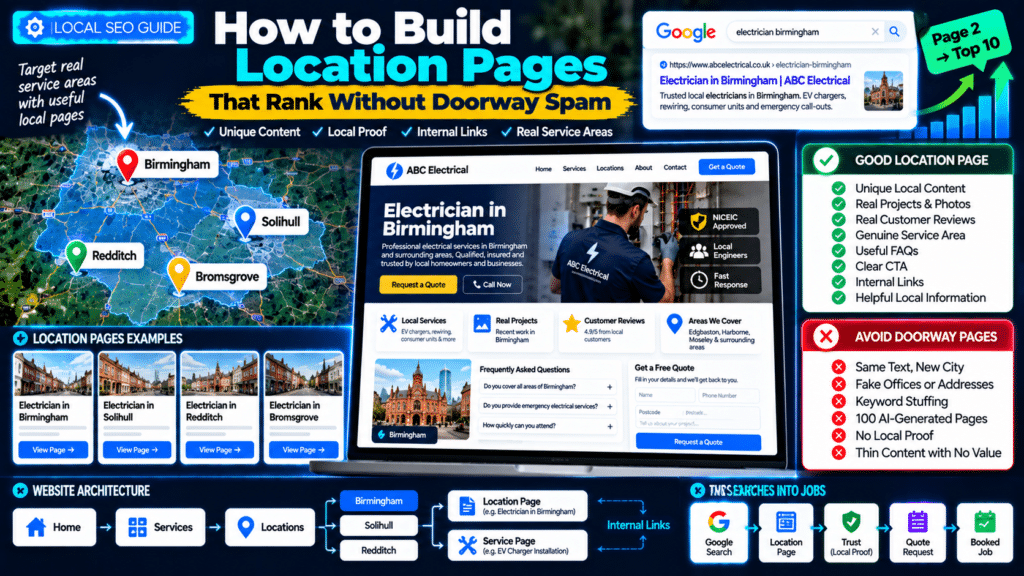
The Best Location Page Structure
A practical location page can follow this structure:
H1
↓
Local Introduction
↓
Services Available in That Area
↓
Why Customers in This Area Choose You
↓
Recent Local Work
↓
Local Reviews
↓
Areas / Neighborhoods Covered
↓
How the Service Works
↓
FAQs
↓
Final CTA
The structure itself is not a ranking factor.
Its value is that it encourages you to provide useful information rather than generic filler.
Write a Strong Local H1
Good:
Electrician in Solihull
Good:
Professional Plumbing Services in Birmingham
Good:
House Cleaning Services in Redditch
Weak:
Welcome to Our Birmingham Page
Weak:
Best Services Near You
The main heading should make the location and service clear.
Google’s helpful-content guidance encourages descriptive page headings and titles that accurately summarize the content (source: Google for Developers).
Write a Unique Introduction
A location-page intro should explain:
- what you provide;
- where you provide it;
- who the service is for.
Example:
Looking for a qualified electrician in Solihull? We provide residential and commercial electrical services across Solihull and surrounding areas, including fault finding, consumer-unit upgrades, EV charger installation and electrical inspections.
That immediately establishes:
- service;
- location;
- relevance.
Avoid:
We are your trusted local experts providing high-quality solutions tailored to your needs.
That could describe almost any business in any city.
Add Local Service Information
Do not just repeat the same master service list.
Explain what services are particularly relevant in that market.
For example:
Electrical Services We Provide in Solihull
EV Charger Installation
Installation for residential properties and businesses.
Consumer Unit Upgrades
Replacement and testing of older electrical boards.
Electrical Inspections
Testing for homeowners, landlords and businesses.
Emergency Electrical Repairs
Fault diagnosis and urgent electrical support.
If a service is not actually available in the location, do not include it.
Add Real Local Project Examples
This is one of the best ways to make location pages unique.
Example:
Recent Electrical Work in Solihull
Project: EV Charger Installation
Property: Detached residential home
Area: Shirley, Solihull
Work Completed:
- electrical assessment;
- charger installation;
- protective device installation;
- commissioning;
- customer setup.
This is far more convincing than adding another paragraph about being:
professional, reliable and affordable.
Use Real Local Photos
If possible, include images from work completed in that location.
For example:
- finished driveway;
- boiler replacement;
- roofing project;
- EV charger installation;
- landscaping project.
Real photos provide evidence that the business actually works there.
Avoid pretending stock photography represents local projects.
Add Local Reviews
A customer review from the location is highly relevant.
For example:
“The team installed our EV charger in Solihull and explained the setup clearly. Everything was completed neatly and on schedule.”
Only use genuine reviews.
If you do not have a location-specific review yet, use a real broader customer review rather than inventing one.
Mention Neighborhoods Naturally
A Birmingham page might genuinely mention areas such as:
- Edgbaston;
- Harborne;
- Sutton Coldfield;
- Moseley.
But do not create a giant keyword block with 80 neighborhood names.
A useful section could be:
Areas We Cover Around Birmingham
We regularly work with customers across Birmingham, including Edgbaston, Harborne, Moseley and surrounding areas. If you’re unsure whether we cover your postcode, contact us before booking.
That is enough.
Add Useful Local Context
This is where location pages become genuinely different.
Depending on the service, useful context could include:
- typical property types;
- local access issues;
- parking considerations;
- common building styles;
- local climate;
- commercial zones.
For example:
Many older properties in central Birmingham and surrounding neighborhoods have electrical systems that have been modified several times over the years. When carrying out upgrade work, we often begin with testing to understand the existing installation before recommending changes.
This is locally relevant and useful.
Do not force local trivia into every page.
The information should relate to the service.
Explain Travel or Response Times Carefully
If your business genuinely offers fast local response, you can explain it.
Example:
Because we regularly schedule technicians across Solihull, we can often combine nearby jobs efficiently.
Avoid promising:
30-minute response anywhere in Birmingham
unless the business can actually deliver that consistently.
Add a Local CTA
A CTA should match the page.
For example:
Get a Plumbing Quote in Birmingham
or:
Book an Electrician in Solihull
That is stronger than:
Submit
Useful CTA choices include:
- Call Now
- Request a Quote
- Book a Survey
- Check Availability
- Schedule a Visit
Add Local FAQs
Good location-page FAQs answer genuine questions.
For example:
Related guides
- How to Build Service Pages That Rank on Google in 2026
- Best Local SEO Tools for Service Businesses in 2026: 6 Tools Compared
- Best Website Builders for Service Businesses in 2026: 5 Platforms Compared
- Tools, Software and Automation for Trades: Start Here
Frequently Asked Questions
Do you cover all of Solihull?
Do you provide emergency electrical services in Birmingham?
How quickly can you attend?
Do you charge for travel?
Do you work with commercial properties?
These are useful.
Avoid artificial keyword questions such as:
Are you the best electrician Solihull electrician services company?
That reads like SEO spam.
Use One Main Intent Per Location Page
A strong page should have a clear purpose.
For example:
Plumber in Birmingham
could cover general plumbing.
Then:
Boiler Repair in Birmingham
may deserve its own page if:
- boiler repair is commercially important;
- search demand exists;
- you can provide substantial unique content.
Do not create:
- boiler repair Birmingham;
- boiler fixing Birmingham;
- Birmingham boiler repairs;
- boiler repair service Birmingham;
as separate pages.
Those are effectively the same intent.
Avoid Creating Every Possible Service + City Combination
Imagine you offer:
10 services
across:
20 locations.
That gives:
200 possible pages.
Technically, you could create them.
That does not mean you should.
This is where scaled-content risk grows.
Google’s spam policy says scaled content abuse includes producing many pages primarily to manipulate search rankings, including AI-generated pages that add little user value (source: Google for Developers).
A better approach is:
Tier 1 Locations
Create deep location pages.
Tier 2 Locations
Mention them naturally within a broader service-area page.
Tier 3 Locations
Do not create a dedicated page unless demand and business activity justify it.
A Better Local SEO Architecture
A service business could use:
Home
↓
Services
↓
Boiler Repair
↓
Locations
↓
Birmingham
↓
Solihull
↓
Redditch
Then selectively create:
Boiler Repair Birmingham
only if that combination deserves a dedicated page.
This avoids exploding the site into hundreds of nearly identical URLs.
Service Area Hub Pages Can Work Well
Instead of creating dozens of tiny city pages, consider a useful hub page.
Example:
Areas We Serve
Then explain:
- Birmingham;
- Solihull;
- Redditch;
- Bromsgrove.
Each important city can link to a deeper page.
This provides a clear hierarchy.
Internal Linking for Location Pages
Internal links help users and search engines understand how pages relate.
Useful links include:
From Home
Link to major location pages.
From Services
Link to important service + location pages where relevant.
From Blog Posts
Link to the matching service page.
Between Location Pages
Only when useful.
For example:
We also provide electrical services in nearby Solihull and Redditch.
Avoid massive sitewide footer links to every city and every service combination.
Link Location Pages Back to Service Pages
Example:
Location page:
Electrician Birmingham
links to:
- EV Charger Installation
- House Rewiring
- Electrical Inspection
This tells the user:
where
and then lets them explore:
what service.
Similarly, each service page can link back to major service areas.
Use Descriptive Anchor Text
Good:
boiler repair in Birmingham
Good:
our electrical inspection service
Weak:
click here
Descriptive links make navigation clearer for both people and search systems.
SEO Titles for Location Pages
A good title might be:
Electrician in Solihull | ABC Electrical
or:
Plumber Birmingham | Emergency & Domestic Plumbing | ABC Plumbing
Keep titles:
- readable;
- descriptive;
- unique.
Do not write:
Plumber Birmingham | Best Plumber Birmingham | Cheap Plumber Birmingham | Plumbing Birmingham
That looks manipulative and provides a poor search result.
Meta Description Example
Looking for a plumber in Birmingham? We provide domestic plumbing, emergency repairs and installations across Birmingham and surrounding areas. Request a quote today.
The description should reflect the actual page.
Do not copy the same description to every city.
URL Structure
Good:
/locations/birmingham/
Good:
/electrician-birmingham/
Good:
/locations/solihull/electrical-services/
There is no one perfect structure.
Choose something:
- logical;
- readable;
- maintainable.
Avoid deeply confusing URLs.
Should You Use LocalBusiness Schema on Every Location Page?
Be careful.
Google supports LocalBusiness structured data and recommends defining each actual local business location as a LocalBusiness, using the most specific relevant subtype (source: Google for Developers).
That does not mean every service area page represents a physical business location.
If you have one real business location serving multiple cities, do not mark every city page as a separate physical branch.
That can create misleading structured data.
Use schema to represent reality.
Physical Location vs Service Area
These are different.
Physical Location
You have:
- real premises;
- staff;
- signage;
- legitimate business operations there.
Service Area
You travel to customers in the area but do not operate a physical office there.
Your website should not blur that distinction.
If the page says:
Our Birmingham Office
you should genuinely have a qualifying Birmingham office.
Google Business Profile and Website Location Pages
Do not assume creating a city page automatically improves your Google Business Profile visibility in that city.
Website SEO and Maps visibility overlap, but they are not identical systems.
Google says service-area businesses should use accurate service areas and can list up to 20 areas (source: Google Help).
Your website should reinforce reality, not try to invent locations Google Business Profile does not support.
Google Business Profile Service Areas
Current Google guidance says:
- service-area businesses can list up to 20 areas;
- areas should be specific;
- service boundaries generally should not extend more than about two hours of driving time from the business base (source: Google Help).
If customers do not visit your address, Google says you should remove the public address and use service areas instead (source: Google Help).
This is especially relevant for:
- plumbers;
- cleaners;
- mobile mechanics;
- electricians;
- landscapers.
Do Not Make Location Pages Just to Support Fake GBP Profiles
One of the worst strategies is:
- create a city landing page;
- rent a mailbox;
- create another Business Profile;
- pretend the business has another branch.
Google’s guidelines say service-area businesses cannot list a virtual office unless it meets legitimate operational requirements, including actual staffing during business hours where applicable (source: Google Help).
Build real local authority instead.
Add Unique Local Proof
Useful local proof can include:
- completed projects;
- photos;
- testimonials;
- local commercial customers;
- neighborhood knowledge.
This is one of the strongest ways to distinguish pages.
Add Unique Local FAQs
Different areas may genuinely have different questions.
For example, one location might ask more about:
- parking;
- permits;
- access.
Another may ask about:
- rural travel;
- large properties;
- commercial sites.
That creates useful differentiation.
Mention Real Availability
Example:
We usually schedule Birmingham jobs Monday through Saturday.
or:
Commercial appointments are available outside normal opening hours by arrangement.
Only include this if it is true.
Do Not Invent Local Statistics
Avoid writing:
87% of Birmingham homeowners need boiler servicing every year.
unless you have a real source.
Made-up statistics weaken trust.
Do Not Fake Local Expertise With AI
AI can help create a first draft.
But AI may invent:
- neighborhoods;
- road names;
- project history;
- service details.
Do not publish those claims without verification.
Google’s people-first guidance emphasizes trust, first-hand expertise and clear authorship or business credibility where appropriate (source: Google for Developers).
Use AI to organize real business knowledge.
Not manufacture it.
AI-Assisted Location Page Workflow
A good process is:
Step 1: Collect Real Information
Gather:
- service area;
- neighborhoods;
- completed projects;
- reviews;
- photos;
- local questions.
Step 2: Build a Page Brief
Define:
- primary intent;
- target service;
- CTA;
- unique local elements.
Step 3: Use AI for Drafting
Ask AI to organize the information.
Step 4: Human Review
Verify every:
- place name;
- service claim;
- review;
- technical detail.
Step 5: Add Real Proof
Insert:
- real photos;
- case studies;
- testimonials.
That produces a far stronger page than:
Generate 100 city pages for my plumbing website.
Scaled AI Location Pages Are Risky
Google’s scaled-content abuse policy explicitly says that producing many pages with generative AI or other automation can be abusive when the primary purpose is manipulating search rankings and the pages add little value (source: Google for Developers).
The issue is not simply:
AI was used.
The issue is:
Why was the content created, and does it actually help users?
Use AI as a productivity tool.
Do not use it as a city-page factory.
Example of a Weak Location Page
Plumber in Birmingham
We are the best plumbers in Birmingham. Our Birmingham plumbers provide professional plumbing services throughout Birmingham. If you need a Birmingham plumber, contact our Birmingham plumbing team.
Then:
- generic services;
- stock image;
- generic testimonial;
- CTA.
Now duplicate it 30 times.
That is low value.
Example of a Strong Location Page
Plumber in Birmingham
Intro explaining:
- service availability;
- customer types;
- local coverage.
Then:
Plumbing Services in Birmingham
Real service list.
Recent Plumbing Work in Harborne
Real project.
Common Plumbing Problems We Help With
Useful customer information.
Birmingham Areas We Regularly Cover
Real neighborhoods.
What to Expect When You Book
Clear process.
Customer Review From Birmingham
Real review.
FAQs
Useful local questions.
Request a Plumbing Quote in Birmingham
Clear CTA.
That page has a real purpose.
Example Location Page Template
[Service / Business Type] in [Location]
Unique local introduction.
Services We Provide in [Location]
Explain actual services.
Recent Work in [Location]
Add real examples.
Why Customers in [Location] Choose Us
Use genuine differentiators.
Areas Around [Location] We Cover
Mention real nearby areas.
How Our Service Works
Explain the process.
Customer Reviews
Use genuine feedback.
Frequently Asked Questions
Answer useful local questions.
Get a Quote in [Location]
Strong final CTA.
How Many Location Pages Should You Create?
There is no correct number.
A small business may need:
3–8 excellent pages.
A larger regional company may legitimately need:
20+ location pages.
The question is not:
How many pages can I publish?
The question is:
How many locations can I cover with genuinely useful, differentiated content?
That should determine the number.
Should Every Location Page Be 2,000 Words?
No.
There is no magic word count.
Google’s helpful-content guidance focuses on:
- originality;
- completeness;
- value;
- user usefulness;
rather than minimum article length (source: Google for Developers).
A strong page may be:
800 words.
Another may need:
1,800 words.
Write what the page needs.
Should You Index Every Location Page?
Only index pages worth appearing in search.
If a location page has:
- no unique content;
- no proof;
- no meaningful purpose;
consider improving it or removing it rather than publishing it purely for SEO.
More indexed pages do not automatically mean more organic traffic.
Merge Weak Location Pages When Needed
Suppose you have:
- Electrician Village A
- Electrician Village B
- Electrician Village C
and each page has almost no unique content.
It may be better to create one useful page:
Electrical Services Across North Birmingham
and mention those areas naturally.
Consolidation can make the site easier to maintain and improve page quality.
Track Location Pages in Search Console
After publishing, monitor:
- impressions;
- clicks;
- queries;
- ranking location;
- indexing.
If the Birmingham page receives searches for:
electrician edgbaston
that may justify adding a useful subsection about Edgbaston.
Do not automatically create another page.
First see whether the existing page can satisfy the query.
Look at Leads, Not Rankings Alone
The purpose of a location page is not simply to rank.
Track:
- calls;
- quote requests;
- form submissions;
- booked jobs.
A page ranking number four and generating ten jobs can be more valuable than a page ranking number one for a low-value query.
Common Location Page SEO Mistakes
Copying the Same Page Across Cities
This is the classic problem.
Creating Every Possible City + Service Combination
Only create pages with real value.
Fake Local Offices
Do not misrepresent service areas as physical branches.
Keyword Stuffing
Use natural language.
No Local Proof
Add real:
- projects;
- reviews;
- images.
No Internal Links
Connect pages logically to services and nearby locations.
Using Fake Local Photos
Use real work where possible.
Mass AI Generation
AI-generated scale without unique value can fall into scaled-content abuse patterns (source: Google for Developers).
No Conversion Path
Every page should make the next step obvious.
Location Page SEO Checklist
Before publishing, ask:
- Do we genuinely serve this area?
- Does this page have a unique purpose?
- Is the title unique?
- Is the H1 clear?
- Is the intro locally relevant?
- Are services accurate?
- Are projects real?
- Are reviews genuine?
- Are neighborhoods relevant?
- Is there useful local context?
- Are internal links added?
- Is the CTA clear?
- Does the page avoid fake location claims?
- Is schema accurate?
- Is the content substantially different from our other city pages?
- Would this page still be useful if Google did not exist?
That last question is especially useful.
If the page only exists for Google, rethink it.
Frequently Asked Questions
Are location pages bad for SEO?
No. Location pages can be useful when they genuinely help users in a specific area.
The problem is mass-producing substantially similar pages mainly to rank for city or regional queries, which can fall under Google’s doorway-abuse policies (source: Google for Developers).
What is a doorway page?
Google describes doorway abuse as pages or sites created to rank for similar, specific queries that mainly funnel users toward another destination or provide little unique value. Its examples include multiple substantially similar pages targeting regions or cities (source: Google for Developers).
Can I create a page for every city I serve?
You can create pages where they provide genuine unique value.
Do not assume every city needs a dedicated page.
A smaller number of strong pages is often better than dozens of near-duplicates.
Can AI create my location pages?
AI can help draft location pages, but you should provide real local data and review everything carefully.
Mass-generating low-value pages primarily for rankings may fall under Google’s scaled-content abuse policy (source: Google for Developers).
How many service areas can I add to Google Business Profile?
Google currently allows up to 20 service areas and recommends keeping the overall service area within roughly two hours of driving time from the business base (source: Google Help).
Should service-area businesses show their home address?
If customers do not visit the business address, Google says the address should be removed from the public profile and service areas should be used instead (source: Google Help).
Can I use a virtual office for a Google Business Profile?
Generally not unless it genuinely meets Google’s requirements for a staffed business location. Google specifically says service-area businesses cannot list virtual offices that do not meet these requirements (source: Google Help).
Should I use LocalBusiness schema on every city page?
Only if the markup accurately represents the business.
Google recommends defining actual business locations using appropriate LocalBusiness structured data. A service-area page does not automatically represent a separate physical location (source: Google for Developers).
How long should a location page be?
There is no fixed word count.
Write enough to provide meaningful local value without adding filler.
What makes a location page unique?
Useful differentiators include:
- real local projects;
- local customer reviews;
- genuine neighborhood coverage;
- relevant local service information;
- local photos;
- specific FAQs.
Conclusion
Learning how to build location pages that rank is not about replacing one city name with another.
A strong location page should answer:
Do you actually work here?
What do you provide here?
What evidence do you have?
How can I book you?
Google’s spam policies specifically warn against doorway pages targeting similar city or regional searches when those pages are substantially similar and offer little unique value (source: Google for Developers).
Google also warns against generating large amounts of low-value content—including through AI—when the primary goal is manipulating search rankings rather than helping users (source: Google for Developers).
So the safest and strongest strategy is:
Real Location
↓
Real Service
↓
Real Local Proof
↓
Useful Information
↓
Clear CTA
Build location pages around:
- real customers;
- real projects;
- real service areas;
- real expertise.
Use AI to help organize and write.
Do not use it to invent local authority.
Your location-page strategy might look like:
Home
↓
Services
↓
Locations
↓
Birmingham
↓
Solihull
↓
Redditch
with deeper service + city pages created only where there is enough genuine demand and content.
The goal is not:
“Create as many city pages as possible.”
It is:
“Create the best page for customers in each location that genuinely matters to the business.”
When you do that, local SEO becomes more sustainable, easier to maintain and far less likely to look like doorway spam.