A service business can have a great team, strong reviews and excellent work—but still struggle if customers cannot find it.
That usually leads to one major marketing question:
Should we invest in Google Ads or SEO?
For plumbers, electricians, HVAC companies, roofers, cleaners, landscapers and other local service businesses, both can generate customers.
But they work very differently.
Google Ads can put your business in front of potential customers quickly.
SEO can build organic visibility that continues attracting customers over time.
A simple way to think about the difference is:
Google Ads = Pay for immediate visibility
SEO = Build long-term visibility
Neither is automatically better.
The right choice depends on:
- how quickly you need leads;
- your budget;
- your competition;
- your website;
- your service type;
- how well you track leads;
- whether you want short-term or long-term growth.
For many service businesses, the strongest strategy is not:
Google Ads OR SEO
but:
Google Ads + SEO
used for different purposes.
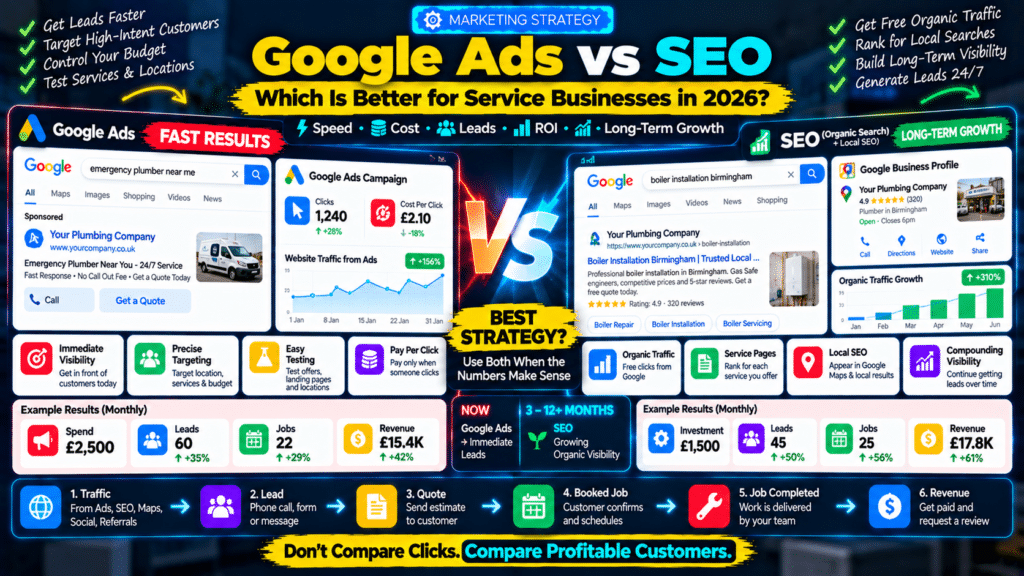
Google Ads vs SEO: Quick Comparison
| Factor | Google Ads | SEO |
|---|---|---|
| Speed | Fast | Slower |
| Upfront Visibility | Excellent | Limited initially |
| Pay Per Click | Yes | No |
| Stops When Budget Stops | Usually | No |
| Long-Term Compounding | Limited | Strong |
| Testing Offers Quickly | Excellent | Slower |
| Local Service Pages | Useful landing pages | Essential |
| Predictability | More controllable | Less immediate |
| Tracking | Usually easier | More complex |
| Competitive Keywords | Can become expensive | Can take longer to rank |
| Best For | Immediate demand | Sustainable organic growth |
What Is Google Ads?
Google Ads is Google’s paid advertising platform.
A service business can pay to appear for searches such as:
- emergency plumber near me;
- electrician Birmingham;
- AC repair;
- roof repair;
- house cleaning near me.
When someone searches, your ad may appear above or around organic search results.
You usually pay when someone clicks.
This is commonly called:
PPC — Pay Per Click.
Example
A customer searches:
boiler repair Birmingham
Your ad appears.
↓
Customer clicks.
↓
Visits your landing page.
↓
Calls your business.
↓
Books repair.
The advantage is speed.
You do not have to wait months for a new page to rank organically.
What Is SEO?
SEO stands for:
Search Engine Optimization.
It involves improving your website and online presence so search engines can understand and rank your business organically.
For a service business, SEO may involve:
- service pages;
- location pages;
- website structure;
- technical SEO;
- Google Business Profile;
- internal linking;
- reviews;
- local citations;
- helpful content.
For example, instead of paying for:
boiler repair Birmingham
every time someone clicks, your goal is to have a useful page rank naturally.
SEO Does Not Mean “Free”
This is important.
Organic clicks do not have a direct cost per click.
But SEO still requires investment.
That may include:
- content;
- web development;
- technical work;
- local SEO;
- tools;
- photography;
- link acquisition;
- ongoing optimization.
So the comparison is not:
Paid vs Free
It is:
Paid traffic vs investment in organic visibility.
Biggest Difference: Speed
This is usually the clearest difference.
Google Ads Can Generate Leads Quickly
If the campaign is configured properly, Google Ads can potentially start producing traffic as soon as it is active.
That makes it useful when:
- the business is new;
- you need leads immediately;
- you are entering a new location;
- you are launching a new service;
- organic rankings are weak.
SEO Takes Longer
SEO usually requires time for:
- pages to be discovered;
- content to be evaluated;
- site authority to develop;
- local relevance to strengthen.
A newly published service page should not be expected to dominate competitive local searches immediately.
That makes SEO less suitable when the business urgently needs customers next week.
Speed Winner
Google Ads.
If the priority is:
generate demand now
Ads usually has the advantage.
Google Ads Stops When You Stop Paying
This is one of the biggest weaknesses of paid traffic.
Imagine your campaign spends:
£100 per day.
If you pause it:
£0 spend
often means:
no more ad traffic.
The visibility does not usually continue.
That makes paid traffic dependent on continued budget.
SEO Can Continue Producing Traffic
A strong service page may continue attracting visitors long after it was created.
For example:
Emergency Plumbing
may continue generating:
- impressions;
- clicks;
- calls;
without paying for every individual visitor.
That gives SEO a compounding effect.
You invest in an asset:
the page.
That asset can potentially continue producing value.
Long-Term Winner
SEO.
Strong organic visibility can become a durable marketing asset.
Google Ads Gives You More Immediate Control
With ads, you can control:
- keywords;
- locations;
- schedule;
- budget;
- landing pages;
- messaging.
For example:
You could decide:
Only show our emergency plumbing campaign between 6 PM and midnight in Birmingham.
That level of campaign control is difficult to achieve with organic search.
SEO Is Less Directly Controllable
You can optimize your site.
But you cannot tell Google:
Rank us #1 tomorrow.
SEO depends on:
- competition;
- relevance;
- quality;
- authority;
- technical health;
- search systems.
That makes it less predictable in the short term.
Control Winner
Google Ads.
Which Produces Better Leads?
There is no universal answer.
Lead quality depends heavily on:
- keyword;
- service;
- landing page;
- targeting;
- reputation;
- price;
- sales process.
A Google Ads lead can be extremely valuable.
An SEO lead can also be extremely valuable.
The important difference is where the customer entered the journey.
High-Intent Google Ads Search
Someone searches:
emergency plumber near me
That person may be ready to book immediately.
Ads can capture that demand.
High-Intent Organic Search
Someone searches:
boiler repair Birmingham
and clicks an organic service page.
That visitor may be equally ready to buy.
So do not assume:
organic leads are always better
or:
paid leads are lower quality.
Measure the actual outcome.
Compare Booked Jobs, Not Leads
Suppose:
Google Ads
50 leads.
15 booked jobs.
SEO
30 leads.
18 booked jobs.
SEO generated fewer leads but more customers.
That means lead count alone would be misleading.
Track:
Lead → Qualified Lead → Booked Job → Revenue
Cost Per Lead: Google Ads
Google Ads makes cost per lead easy to calculate.
Example:
Ad spend:
£2,000
Leads:
40
Cost per lead:
£50
Formula:
£2,000 ÷ 40 = £50
But this is still not enough.
Cost Per Booked Job
If those 40 leads produce:
16 jobs
your real acquisition cost is closer to:
£125 per booked job
because:
£2,000 ÷ 16 = £125
That is a much more useful number.
Calculating SEO Cost
SEO is harder to measure because costs are usually spread across:
- website work;
- content;
- SEO retainers;
- tools;
- technical improvements.
Example:
Monthly SEO investment:
£1,500
Organic leads:
50
You might initially calculate:
£30 per lead.
But SEO can continue benefiting from work performed in earlier months.
That is why long-term measurement matters.
SEO Often Becomes More Efficient Over Time
Imagine:
Month 1
SEO spend: £1,500
Leads: 10
Cost per lead: £150
Month 12
SEO spend: £1,500
Leads: 80
Cost per lead: £18.75
This example is simplified, but it demonstrates the compounding nature of organic visibility.
As more pages rank and the website gains strength, the same monthly investment may produce more leads.
Google Ads Costs Can Increase With Competition
If more companies bid on:
emergency plumber
the cost per click may increase.
Your results may therefore depend on:
- competitors;
- Quality Score;
- conversion rate;
- bidding strategy;
- geographic market.
You cannot assume the same ad budget will generate the same lead volume forever.
SEO Competition Exists Too
SEO is not immune to competition.
If competitors invest heavily in:
- stronger sites;
- better content;
- reviews;
- links;
- local authority;
ranking can become difficult.
The difference is that SEO competition is usually not priced through a direct auction for every click.
Google Ads Is Excellent for Testing
This is one of its most underrated advantages.
Suppose you want to introduce:
heat pump installation.
Instead of spending months creating a large SEO campaign, you can test paid demand.
Create:
Heat Pump Landing Page
↓
Run Google Ads.
↓
Measure:
- clicks;
- leads;
- quote requests;
- jobs.
If demand is strong, invest more aggressively in long-term SEO.
Ads Winner for Testing
Google Ads.
It is generally faster for validating:
- offers;
- services;
- locations;
- landing pages.
SEO Is Better for Building Content Assets
Suppose you create:
EV Charger Installation
Then supporting content:
- How Much Does EV Charger Installation Cost?
- Home vs Commercial EV Chargers
- How Long Does Installation Take?
- EV Charger Installation FAQs
These pages can build a useful organic topic cluster.
That is difficult to reproduce through advertising alone.
SEO Winner for Content Assets
SEO.
Google Ads Requires a Strong Landing Page
Running ads to a poor website is one of the fastest ways to waste money.
Imagine paying:
£5 per click
to send people to a page that:
- loads slowly;
- has no phone number;
- has weak trust;
- has no clear CTA;
- barely explains the service.
You are paying for traffic but losing the customer after the click.
A Strong Google Ads Landing Page Should Include
- clear service;
- location;
- phone number;
- quote CTA;
- reviews;
- trust signals;
- useful service information;
- mobile-friendly design.
The better the conversion rate, the more useful your ad spend becomes.
SEO Also Benefits From Strong Service Pages
The same page improvements often help SEO.
A strong page should answer:
- what the service is;
- who it is for;
- where it is available;
- what happens next.
This is why SEO and paid search are not completely separate.
A well-built website improves both.
Google Ads vs SEO for Emergency Services
For urgent services such as:
- emergency plumbing;
- locksmiths;
- AC repair;
- electrical faults;
Google Ads can be extremely valuable.
The customer may search:
“emergency electrician near me”
and call immediately.
There is little research phase.
Speed matters.
Winner for Emergency Demand
Often:
Google Ads.
But strong Maps and organic visibility can also be extremely valuable.
Google Ads vs SEO for High-Value Services
For larger services such as:
- new roof;
- full rewiring;
- solar installation;
- kitchen renovation;
- commercial HVAC;
customers may research more before buying.
They may:
- compare companies;
- read guides;
- check reviews;
- revisit websites.
SEO can become very powerful here because customers may enter through multiple pages before requesting a quote.
Winner for Research-Heavy Services
Often:
SEO, especially long term.
But paid search can still capture high-intent customers.
Google Ads vs SEO for a New Business
A brand-new business usually has:
- little website authority;
- few organic rankings;
- limited brand awareness.
Waiting only for SEO can create a difficult first few months.
A strong strategy may be:
Google Ads for immediate visibility
SEO from day one for long-term growth.
This creates:
Short-Term Leads + Long-Term Asset Building.
Google Ads vs SEO for an Established Business
An established business may already have:
- reviews;
- strong service pages;
- organic rankings;
- brand demand.
In that case, SEO may already generate substantial leads.
Ads can then be used strategically for:
- high-margin services;
- new locations;
- competitive keywords;
- seasonal campaigns.
Google Ads vs SEO for Multiple Locations
If you are expanding into a new location, Ads can help test it quickly.
For example:
Your business currently serves:
Birmingham
and wants to expand into:
Solihull.
You could:
- create a proper Solihull landing page;
- run targeted ads;
- measure lead quality;
- build long-term local SEO if the market performs well.
This can reduce guesswork.
Local SEO Adds Another Layer
When comparing Google Ads and SEO for service businesses, do not forget:
Google Business Profile.
For local searches, customers may see:
- paid ads;
- local / Maps results;
- organic results.
A strong strategy can potentially occupy multiple parts of the results page.
Example Search Presence
Customer searches:
plumber Birmingham
They might see:
Google Ad
your business.
Then:
Google Maps result
your business.
Then:
Organic service page
your business.
That repeated visibility can increase trust and brand recognition.
Google Ads Can Reveal Valuable SEO Keywords
Paid search data can help identify:
- high-converting services;
- profitable search terms;
- strong locations.
Those insights can guide SEO.
For example:
Google Ads shows that:
emergency boiler repair
produces many profitable jobs.
You may decide to create or improve an organic page around that service.
SEO Can Improve Paid Campaigns
SEO work often improves:
- landing pages;
- site speed;
- service content;
- trust;
- mobile usability.
Those same improvements can increase conversion from paid traffic.
This is why separating SEO and PPC teams completely can be a mistake.
They should share information.
When Google Ads Is Better
Google Ads may be the stronger choice when:
- you need leads immediately;
- your business is new;
- you are testing a new service;
- you are testing a new location;
- the search is highly commercial;
- you can track calls and forms properly.
When SEO Is Better
SEO may be the stronger choice when:
- you want long-term visibility;
- you serve stable markets;
- you can invest consistently;
- customers research before buying;
- you have useful expertise to publish;
- you want to reduce dependence on paid traffic.
When You Should Use Both
For many service businesses, the answer is:
both.
A balanced strategy might look like:
Google Ads
Targets:
- emergency;
- high-value;
- new services;
- immediate demand.
SEO
Builds:
- service pages;
- location pages;
- guides;
- Google Business Profile;
- long-term visibility.
Example Marketing Strategy
A plumbing company has:
£4,000/month marketing budget.
It might allocate:
Google Ads
£2,500
for:
- emergency plumbing;
- boiler repair;
- immediate leads.
SEO
£1,500
for:
- service pages;
- local SEO;
- content;
- technical improvements.
The correct split depends entirely on:
- margins;
- competition;
- growth stage.
Do Not Split Budget Without Tracking
The biggest mistake is deciding:
50% Ads / 50% SEO
without knowing which channel produces revenue.
Track:
- spend;
- leads;
- qualified leads;
- booked jobs;
- revenue;
- profit.
Then adjust.
How to Compare Google Ads and SEO Fairly
Use the same outcome metrics.
For both channels, measure:
Leads
How many enquiries?
Qualified Leads
How many were genuine opportunities?
Booked Jobs
How many became customers?
Revenue
What did those jobs generate?
Cost Per Booked Job
What did acquisition cost?
Average Job Value
Are certain channels generating larger projects?
Example Comparison
| Metric | Google Ads | SEO |
|---|---|---|
| Monthly Cost | £2,500 | £1,500 |
| Leads | 60 | 45 |
| Qualified Leads | 42 | 38 |
| Booked Jobs | 22 | 25 |
| Revenue | £15,400 | £17,800 |
| Cost Per Booked Job | £113.64 | £60 |
| Avg. Job Value | £700 | £712 |
In this example:
Google Ads produces more leads.
SEO produces more booked jobs at a lower acquisition cost.
That gives the owner real information for budgeting.
But Do Not Ignore Attribution Problems
Customers may interact with both channels.
For example:
- customer sees an ad;
- does not book;
- later searches your brand;
- clicks organic result;
- calls.
Which channel deserves the credit?
This is why attribution is imperfect.
Use data as a decision tool rather than assuming every journey can be measured perfectly.
First-Touch vs Last-Touch
First-Touch
Credits the first channel.
In the example above:
Google Ads.
Last-Touch
Credits the final interaction.
That would be:
Organic Search.
For most small service businesses, you do not need a complicated attribution model.
Start by tracking the main lead source consistently.
Do Not Measure SEO Only by Rankings
Ranking #1 feels good.
But if the keyword generates no customers, it has limited business value.
Track:
Organic Search → Lead → Job → Revenue
not only:
Keyword Position.
Do Not Measure Google Ads Only by Clicks
The same rule applies.
A campaign producing:
1,000 clicks
but:
three jobs
may be poor.
Another producing:
200 clicks
and:
30 jobs
may be excellent.
Clicks are only one step.
Website Conversion Rate Can Change the Winner
Imagine two companies run the same advertising campaign.
Company A
Landing-page conversion rate:
2%.
Company B
Conversion rate:
10%.
Company B can often afford to bid more because the website converts more visitors into leads.
That means the Google Ads vs SEO decision is also influenced by:
website quality.
Improve Your Website Before Scaling Ads
Before increasing ad spend, check:
- mobile speed;
- service-page clarity;
- phone number visibility;
- quote form;
- reviews;
- trust;
- service area;
- CTA.
Sometimes the problem is not traffic.
It is conversion.
Improve SEO Before Creating Hundreds of Pages
Similarly, do not respond to weak rankings by creating:
- 100 city pages;
- 100 thin blog posts.
Focus first on:
- strong services;
- major locations;
- internal links;
- real expertise;
- useful content.
Quality should come before scale.
Seasonality Changes the Strategy
Service demand is not always consistent.
HVAC companies may see:
- strong AC demand in summer;
- heating demand in winter.
Landscaping may peak in warmer periods.
Ads can be scaled up or down rapidly during those seasons.
SEO requires more planning because organic visibility should ideally exist before peak demand begins.
Example Seasonal Strategy
An HVAC company wants to rank for:
AC repair.
Do not start SEO in the middle of the hottest week and expect instant results.
Build the page months earlier.
Then during peak season:
SEO captures organic demand
while:
Google Ads increases immediate visibility.
Brand Search Can Affect Ad Reporting
Customers may already know your business and search your brand.
If your ad appears, you may pay for a click from someone who was already trying to find you.
This is not always bad.
But separate:
brand campaigns
from:
non-brand campaigns
when evaluating acquisition performance.
Google Ads vs SEO for Small Budgets
If the marketing budget is extremely limited, spreading it across too many channels can reduce effectiveness.
A very small business might begin with:
- strong Google Business Profile;
- good service pages;
- basic local SEO.
Then selectively test ads for one high-value service.
Or, if customers are needed immediately, run a tightly controlled campaign while building SEO in parallel.
Common Google Ads Mistakes
Sending Every Ad to the Homepage
Use relevant landing pages.
Targeting Too Broadly
Service area matters.
No Call Tracking
You cannot measure phone-generated jobs properly.
Measuring Clicks Instead of Revenue
Track real outcomes.
No Negative Keywords
Irrelevant clicks waste budget.
Never Reviewing Search Terms
Search behavior changes.
Common SEO Mistakes
Expecting Immediate Results
SEO is usually a longer-term strategy.
Publishing Thin Pages
More pages do not automatically mean better rankings.
Ignoring Google Business Profile
Local visibility matters.
No Service-Specific Pages
Generic websites make relevance harder.
Tracking Rankings Only
Revenue matters more.
Google Ads vs SEO Checklist
Choose Google Ads more aggressively when:
- immediate leads matter;
- demand already exists;
- you have a strong landing page;
- calls and forms are tracked;
- margins support acquisition costs.
Invest heavily in SEO when:
- long-term growth matters;
- your core services are stable;
- you can publish useful content;
- your website needs stronger organic authority;
- you want to reduce dependence on advertising.
Use both when:
- the budget supports it;
- you can measure both properly;
- short-term and long-term growth both matter.
Sources and Further Reading
These official resources back up the methods in this guide and are worth reading alongside it.
- SEO Starter Guide (Google Search Central): how Google finds and ranks pages.
- Marketing and sales (U.S. Small Business Administration): planning and measuring marketing for a small business.
Related guides
- Best Local SEO Tools for Service Businesses in 2026: 6 Tools Compared
- How to Automate Review Requests for a Service Business in 2026
- Tools, Software and Automation for Trades: Start Here
Frequently Asked Questions
Is Google Ads better than SEO for service businesses?
Google Ads is generally better for immediate visibility, while SEO is stronger for building long-term organic traffic.
Many service businesses benefit from using both.
Is SEO cheaper than Google Ads?
Not necessarily at the beginning.
SEO still requires investment in content, development and optimization.
However, successful SEO can become more cost-efficient over time because you do not pay directly for every organic click.
How quickly can Google Ads generate leads?
A properly configured campaign can potentially start generating traffic and enquiries soon after going live.
Actual results depend on:
- demand;
- budget;
- competition;
- targeting;
- landing-page quality.
How long does SEO take?
There is no fixed timeline.
Competitive local searches can take months of sustained improvement.
New or low-authority websites generally should not expect immediate top rankings.
Should a new service business use Google Ads?
Often, yes—especially if it needs immediate customers.
But SEO should usually be built at the same time so the business is not permanently dependent on paid traffic.
Does SEO stop working if I stop paying?
Organic visibility does not automatically disappear the moment you stop SEO work.
However, rankings can change over time as:
- competitors improve;
- content becomes outdated;
- search systems evolve.
SEO still requires maintenance.
Should I use Google Ads for emergency services?
Paid search can work particularly well for high-intent emergency queries because customers often need help immediately.
Can SEO generate better-quality leads?
It can.
But lead quality depends on the query, page and customer intent.
Measure actual booked jobs rather than assuming one channel always produces better leads.
Can Google Ads help SEO?
Ads do not directly buy organic rankings.
However, paid-search data can reveal:
- converting keywords;
- profitable locations;
- strong offers;
which can help guide SEO decisions.
Should I run Ads if I already rank organically?
Possibly.
Ads can provide additional visibility for:
- high-value keywords;
- competitive searches;
- promotions;
- new markets.
The decision should be based on incremental leads and profitability.
Conclusion
The Google Ads vs SEO for service businesses decision is not really about choosing a winner.
The two channels solve different problems.
Google Ads is strongest when you need:
- immediate visibility;
- rapid testing;
- precise targeting;
- scalable paid demand.
SEO is strongest when you want:
- long-term organic visibility;
- compounding website assets;
- broader search coverage;
- less dependence on paying for every click.
A new service business might use:
Google Ads → Generate Leads Now
while simultaneously investing in:
SEO → Build Long-Term Visibility
An established business may use SEO as the foundation and Ads strategically for:
- emergency services;
- high-margin jobs;
- new locations;
- seasonal demand.
The most important thing is not whether the customer came from:
paid
or:
organic.
It is whether that channel generated:
qualified leads
↓
booked jobs
↓
profitable revenue.
So instead of asking:
“Which gets more clicks?”
ask:
“Which generates more profitable customers?”
Track:
Marketing Spend → Leads → Booked Jobs → Revenue
and make your decision from there.
That is the difference between marketing based on opinion and marketing based on actual business performance.