Every service business will eventually face an unhappy customer.
A plumber may be called back because a leak returned.
An electrician may receive a complaint about a delayed appointment.
A cleaner may be told part of the property was missed.
A landscaper may hear:
“This is not what I expected.”
Even a well-run business cannot prevent every problem.
What matters is what happens next.
A poor complaint process can turn one issue into:
- an angry customer;
- a refund dispute;
- a negative review;
- a lost referral;
- a damaged reputation.
A strong complaint process can do the opposite.
It can show the customer that the company:
- listens;
- takes responsibility;
- investigates fairly;
- communicates clearly;
- resolves problems professionally.
That is why learning how to handle customer complaints in a service business is an important operational skill.
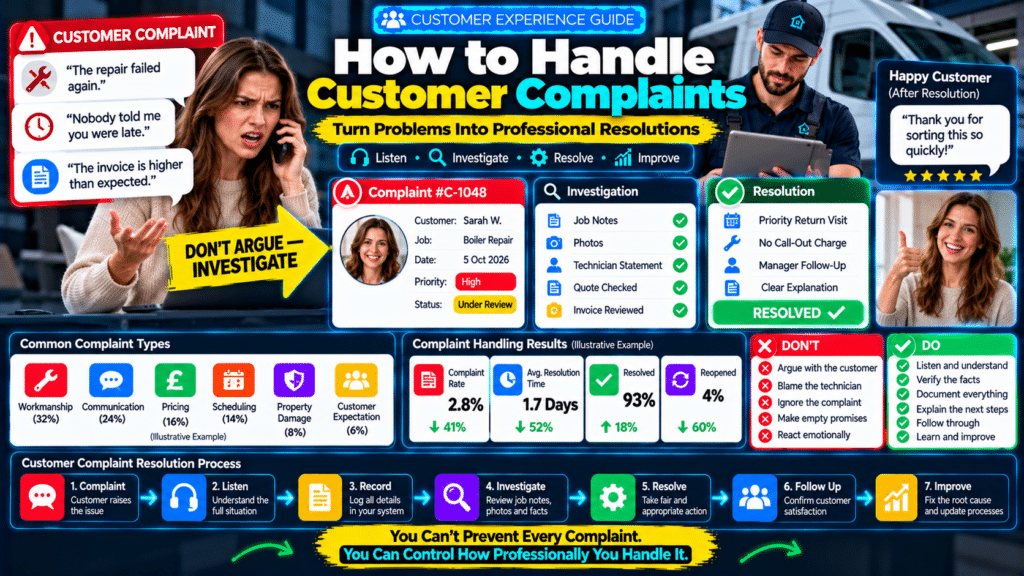
A strong complaint process looks like:
Listen
↓
Acknowledge
↓
Record
↓
Investigate
↓
Decide
↓
Resolve
↓
Follow Up
↓
Improve the Process
The goal is not to “win” an argument.
The goal is to:
solve the problem fairly while protecting the customer relationship and the business.
Why Customer Complaints Matter
A complaint is not only a customer-service issue.
It can reveal problems in:
- technician quality;
- communication;
- pricing;
- scheduling;
- expectations;
- invoicing;
- internal processes.
For example:
A customer complains:
The technician arrived two hours late and nobody told me.
That may look like:
technician problem.
But the real issue could be:
- poor scheduling;
- no delay notification process;
- unrealistic job durations.
Complaints can expose weaknesses that normal daily operations hide.
Do Not Treat Every Complaint as an Attack
When a customer is upset, it is easy for staff to become defensive.
For example:
Customer:
Your technician left a mess.
Poor response:
That doesn’t sound right. Our technician would never do that.
That immediately creates conflict.
A better response is:
I’m sorry to hear that. Let me look into what happened so we can understand it properly and see how to resolve it.
You have not automatically admitted fault.
You have acknowledged the concern.
There is a difference.
Step 1: Listen Before Responding
The first goal is:
understand the complaint.
Do not interrupt repeatedly.
Do not start explaining before the customer has finished.
Let them describe:
- what happened;
- what they expected;
- what went wrong;
- what outcome they want.
Useful questions include:
Can you walk me through what happened?
When did you first notice the issue?
What were you expecting to happen?
What would you consider a fair resolution?
This gives you better information.
Do Not Argue About Emotion
A customer may say:
This was a terrible experience.
You may believe the work itself was technically correct.
But arguing:
No, it wasn’t terrible.
does not help.
Instead separate:
technical facts
from:
customer experience.
You can later determine what actually happened.
Step 2: Acknowledge the Complaint
Acknowledging is not the same as admitting legal responsibility.
It means showing the customer you understand the issue.
For example:
I understand why that would be frustrating, especially after waiting for the appointment.
or:
I can see why you expected the issue to be fully resolved after the visit.
This can reduce tension.
Use the Customer’s Actual Concern
Generic:
Sorry for the inconvenience.
Better:
I’m sorry you had to wait without an update. We should have communicated the delay more clearly.
Specific language feels more genuine.
Step 3: Record the Complaint
Do not rely on memory.
Create a complaint record.
Include:
- customer name;
- original job;
- date;
- technician;
- complaint details;
- photos if relevant;
- desired resolution;
- urgency;
- next action.
Example Complaint Record
Customer:
Sarah Williams
Job:
Boiler Repair #1048
Complaint:
Boiler stopped working again the following morning.
Original Technician:
Alex
Customer Request:
Return visit as soon as possible.
Priority:
High
Status:
Under Investigation
This gives everyone the same information.
Complaints Should Be Linked to the Original Job
This is important.
Do not create an isolated note that says:
Customer unhappy.
Link the complaint to:
- job;
- quote;
- technician notes;
- photos;
- invoice.
That makes investigation much easier.
Step 4: Separate Urgent Complaints From Normal Complaints
Not every complaint has the same priority.
Priority 1: Safety / Serious Risk
Examples:
- dangerous installation;
- gas concern;
- electrical safety concern;
- property damage;
- active leak.
These should be escalated immediately according to qualified technical and legal procedures.
Priority 2: Service Failure
Examples:
- repaired item stopped working;
- work incomplete;
- serious quality issue.
These need fast operational response.
Priority 3: Customer Experience
Examples:
- technician was late;
- communication poor;
- invoice confusing.
Still important, but may not require emergency dispatch.
A priority system helps the office respond correctly.
Step 5: Investigate Before Deciding
Do not issue a refund simply because a customer demands one.
Do not reject the complaint simply because the technician disagrees.
Investigate.
Review:
- job notes;
- before/after photos;
- technician account;
- scope of work;
- quote;
- invoice;
- customer messages.
Ask:
What actually happened?
Speak to the Technician Separately
Do not put the customer and technician into an argument.
Ask the technician:
Walk me through the job from beginning to end.
Then compare:
- documentation;
- customer account;
- technical findings.
The goal is not:
find someone to blame.
The goal is:
find the cause.
Use Photos and Notes
This is where good documentation becomes extremely valuable.
A complaint such as:
The technician damaged the wall.
is easier to investigate if you have:
Before Photo
and:
After Photo.
Without documentation, the situation can become:
customer’s word vs technician’s word.
Step 6: Identify the Complaint Type
Categorize complaints.
Common categories include:
- workmanship;
- misdiagnosis;
- delayed arrival;
- communication;
- pricing;
- invoice;
- property damage;
- cleanliness;
- customer expectation;
- staff behavior;
- failed part.
This helps you track patterns.
Example Monthly Complaint Data
| Complaint Type | Number |
|---|---|
| Late Arrival | 12 |
| Communication | 8 |
| Workmanship | 5 |
| Invoice Confusion | 4 |
| Property Cleanliness | 3 |
| Pricing | 2 |
If:
late arrival
is the biggest problem, your next improvement may need to focus on:
- scheduling;
- route planning;
- customer notifications.
Step 7: Decide on a Fair Resolution
Possible resolutions include:
- return visit;
- repair correction;
- replacement part;
- partial refund;
- full refund;
- credit;
- apology;
- clarification.
The correct response depends on:
- what happened;
- contract;
- warranty;
- customer impact.
Do Not Offer the Same Solution for Every Complaint
A one-hour delay should not automatically receive the same response as:
property damage.
Build escalation rules.
Example Resolution Matrix
Minor Communication Issue
Possible resolution:
- apology;
- explanation;
- follow-up.
Workmanship Issue
Possible resolution:
- priority callback;
- correction;
- supervisor review.
Serious Property Damage
Possible resolution:
- immediate management escalation;
- insurance / legal process where appropriate.
Clear rules prevent inconsistent decisions.
Step 8: Give Employees Clear Authority
One of the worst systems is:
customer asks for £20 credit
↓
office employee calls manager.
↓
manager calls owner.
↓
owner calls customer.
Simple issues become slow.
Give staff defined authority.
For example:
Customer Service Representative
Can approve:
- up to £25 service credit;
- priority reschedule.
Operations Manager
Can approve:
- up to £150 credit;
- technician callback;
- partial refund.
Owner / Director
Required for:
- major refund;
- serious damage;
- legal issue;
- insurance claim.
The exact limits are up to your business.
The principle is:
clear authority.
Step 9: Explain the Resolution Clearly
Do not say:
We’ll sort something out.
Say exactly what happens.
For example:
We’re sending a senior technician tomorrow between 9 and 11 AM to inspect the repair. There will be no call-out charge. After the visit, we’ll update you on the cause and next step.
Clear communication reduces anxiety.
Include Timing
Tell the customer:
- who will contact them;
- when;
- what happens next.
Uncertainty often makes complaints worse.
Step 10: Do What You Promised
This sounds obvious.
But it is where many complaint processes fail.
If you say:
Manager will call today.
the manager should call today.
If you promise:
Technician tomorrow morning.
do not silently move the appointment.
A broken promise during a complaint can be worse than the original problem.
Step 11: Follow Up After Resolution
Do not assume:
technician returned = problem solved.
Follow up.
For example:
Hi Sarah, I’m checking in after yesterday’s visit. Is everything now working as expected?
This confirms the situation is actually resolved.
It also shows professionalism.
Ask One Important Question
Is there anything else we need to address regarding this issue?
That gives the customer one final opportunity to raise concerns.
Complaints Can Become Service Recovery Opportunities
A customer who experiences a problem but sees it resolved well may still remain loyal.
The company demonstrates:
- responsibility;
- responsiveness;
- fairness.
The goal is not to create problems.
But when they happen, strong recovery matters.
Do Not Use Discounts to Avoid Real Problems
Poor process:
Customer:
The technician didn’t fix the problem.
Business:
Here’s 10% off your next job.
That does not solve anything.
Fix the actual issue first.
Discounts and credits are secondary.
When Should You Refund?
Refunds should follow your:
- terms;
- policies;
- applicable law;
- circumstances.
Possible reasons may include:
- service clearly not delivered;
- confirmed serious failure;
- agreement with customer.
Do not create a culture where:
customer complains = automatic refund.
That can encourage inconsistent decisions.
Partial Refund vs Full Refund
A partial refund may make sense when:
- part of the work was completed correctly;
- the customer experienced significant inconvenience.
A full refund may be considered where:
- service fundamentally failed;
- management decides it is appropriate.
Use consistent rules.
Protect Against Refund Abuse
Most customers are genuine.
But some may repeatedly seek:
- discounts;
- free work;
- refunds.
Track customer complaint history.
For example:
Customer has requested compensation on 4 of last 5 jobs.
That deserves management review.
Do not allow staff to be pressured into unreasonable outcomes.
Keep Communication Professional
Avoid:
- sarcasm;
- arguing;
- blaming;
- emotional messages.
Especially in:
- email;
- SMS.
Written communication can be forwarded or posted publicly.
Keep it calm.
Example Poor Response
We already explained this wasn’t our fault. Your system was old and you chose the cheaper repair.
Better Response
We reviewed the original job and the technician’s notes. The repair completed relates to the pressure valve, while the current fault appears to involve a separate component. We’d be happy to inspect it and explain the options before any additional work is approved.
Facts.
No hostility.
Handling Complaints on the Phone
Use a simple structure:
Listen
↓
Acknowledge
↓
Clarify
↓
Explain Next Step
Example:
I understand. Let me make sure I have this right—you had the repair yesterday and the same issue returned this morning. I’m going to review the job notes now and arrange the appropriate next step. Can I place you on hold for two minutes while I check the booking?
Professional and controlled.
Handling Complaints by Email
Reply within a reasonable timeframe.
Structure:
Acknowledge
Thank you for contacting us.
Summarize
I understand your concern relates to…
Action
We are reviewing…
Next Step
We will update you by…
Do not write an essay defending the company before investigating.
Handling Complaints Through Reviews
Sometimes the first complaint appears publicly.
Customer leaves:
1-star Google review.
Do not respond emotionally.
Avoid:
This review is completely false and the customer is lying.
A better public response:
We’re sorry to hear you were unhappy with the experience. We’d like to review what happened and see whether we can help. Please contact our team directly so we can look into the job properly.
Keep specific customer details private.
Then investigate internally.
Do Not Publicly Share Customer Information
Avoid posting:
- address;
- invoice details;
- private conversations;
- payment information.
A public review response should remain professional and limited.
Complaint vs Review Policy Violation
A negative review is not automatically fake.
A customer is allowed to dislike your service.
Only report a review if you have legitimate reason to believe it violates the platform’s policies.
Do not make reporting negative reviews your complaint strategy.
Create a Complaint Handling SOP
Your team should not improvise.
A simple SOP:
Customer Complaint SOP
1. Listen
Allow customer to explain issue.
2. Record
Create complaint record.
3. Prioritize
Classify urgency.
4. Investigate
Review job, notes, photos, technician.
5. Escalate
Follow authority levels.
6. Resolve
Offer appropriate action.
7. Confirm
Explain timeline.
8. Follow Up
Confirm customer satisfaction.
9. Record Outcome
Close complaint.
10. Review Cause
Improve system where needed.
This connects naturally with the SOP system in Blog #80.
Measure Complaint Rate
A simple metric:
Complaints ÷ Completed Jobs × 100
Example:
1,000 jobs.
30 complaints.
Complaint rate:
3%.
Track this over time.
Measure Resolution Time
How long does it take from:
complaint received
to:
resolved?
Example:
Average:
4.2 days
Then aim to improve where practical.
Measure Complaint Reopen Rate
A complaint may be marked resolved but customer contacts you again.
Track:
reopened complaints.
A high reopen rate may indicate:
- poor resolution;
- incomplete investigation;
- weak communication.
Track Compensation Cost
Record:
- refunds;
- credits;
- free return visits.
This reveals the financial impact of customer-service failures.
Track Complaints by Technician
This can reveal:
- coaching needs;
- process issues.
But use context.
A technician completing:
high-risk complex jobs
may naturally receive more complaints than someone doing simple maintenance.
Do not judge only by raw count.
Track Complaints by Service
Example:
Boiler Repairs
4 complaints.
Bathroom Installations
12 complaints.
Why?
Maybe the issue is:
- project expectations;
- subcontractors;
- timelines.
Service-level analysis can be more useful than employee-level analysis.
Track Complaints by Root Cause
Useful categories:
- quality;
- communication;
- scheduling;
- price;
- scope;
- employee behavior;
- supplier;
- process.
Then ask:
Which causes are increasing?
Complaint Example: Late Technician
Customer:
I waited two hours and nobody called me.
Poor resolution:
Sorry.
Better process:
- acknowledge;
- confirm delay;
- apologize;
- give accurate ETA;
- investigate why no notification was sent;
- update scheduling SOP.
Complaint resolved.
Process improved.
Complaint Example: Repeat Repair Failure
Customer:
You repaired this yesterday and it’s broken again.
Process:
- prioritize callback;
- review original job;
- assign senior technician if needed;
- identify root cause;
- correct issue;
- follow up;
- record whether it was:
- workmanship;
- misdiagnosis;
- part failure.
This connects directly with Blog #81 on reducing callbacks.
Complaint Example: Price Shock
Customer:
I didn’t know it would cost that much.
Investigation may reveal:
- quote unclear;
- additional work not approved;
- invoice poorly explained.
The technical work may be perfect.
The problem is:
pricing communication.
Improve:
- quote approval;
- change-order process;
- customer explanation.
Complaint Example: Property Damage
This needs immediate seriousness.
Process may involve:
- photos;
- manager;
- insurance;
- documented communication;
- appropriate professional advice.
Do not have a junior employee casually promise:
We’ll definitely pay for everything.
Follow business policy and relevant legal/insurance procedures.
Common Complaint Handling Mistakes
Becoming Defensive
Listen first.
Automatically Blaming the Technician
Investigate.
Automatically Blaming the Customer
Same problem.
Promising Something You Cannot Deliver
Be realistic.
No Complaint Record
Patterns disappear.
No Follow-Up
You do not know if resolution worked.
Giving Random Discounts
Fix the actual problem.
Making Customers Repeat the Story
Record information properly.
Slow Response
Silence increases frustration.
No Root-Cause Review
Same complaint happens again.
Train Staff for Difficult Conversations
Complaint handling is a skill.
Teach employees:
- how to listen;
- how to acknowledge;
- what not to promise;
- when to escalate.
Role-play common scenarios.
For example:
Scenario
Customer is shouting because technician is late.
Employee practices:
- staying calm;
- not matching tone;
- confirming facts;
- offering next step.
This builds confidence.
Do Not Expect Staff to Accept Abuse
Professional complaint handling does not mean employees must tolerate:
- threats;
- harassment;
- discriminatory abuse;
- physical intimidation.
Create boundaries.
For example:
I’m happy to help resolve the service issue, but I cannot continue the call while being spoken to that way.
If behavior continues, escalate according to company policy.
Staff safety matters.
Create a Complaint Escalation Matrix
Example:
Level 1
Office staff handles:
- scheduling;
- minor communication issue.
Level 2
Operations manager handles:
- workmanship;
- repeated callback;
- significant credit/refund.
Level 3
Owner / senior management handles:
- legal threats;
- serious property damage;
- safety concerns;
- major financial disputes.
This prevents both over-escalation and under-escalation.
Use Complaints in Team Meetings
Do not name and shame employees.
Review patterns.
For example:
We had five complaints this month about customers not receiving delay updates.
Action:
Create automatic delay notification process.
This turns complaints into operational improvement.
Customer Complaint Dashboard
Useful metrics:
Complaints This Month: 14
Complaint Rate: 2.8%
Average Resolution Time: 1.7 days
Resolved: 13
Reopened: 1
Top Cause: Communication
This provides visibility without making the system complicated.
Complaint Handling Checklist
When a complaint arrives:
- Listen fully
- Acknowledge concern
- Record details
- Link original job
- Determine urgency
- Review notes/photos
- Speak to technician if needed
- Identify root cause
- Choose resolution
- Explain next step
- Complete promised action
- Follow up
- Record outcome
- Update process if needed
Sources and Further Reading
These official resources back up the methods in this guide and are worth reading alongside it.
- Manage customer reviews (Google Business Profile Help): how to reply to reviews on your profile.
- The Consumer Reviews and Testimonials Rule: Questions and Answers (Federal Trade Commission): what businesses can and cannot do when asking for reviews.
- How To Avoid a Home Improvement Scam (FTC Consumer Advice): what customers are told to expect in written estimates and contracts.
Related guides
- How to Set Customer Expectations Before a Service Job: 12 Practical Steps
- How to Improve Technician Utilization in a Service Business: Practical Guide
- How to Reduce No-Shows and Last-Minute Cancellations in a Service Business
- Tools, Software and Automation for Trades: Start Here
Frequently Asked Questions
How should a service business handle customer complaints?
Use a structured process:
Listen → Acknowledge → Record → Investigate → Resolve → Follow Up
Avoid arguing or deciding before understanding the facts.
Should I apologize if the complaint is not our fault?
You can acknowledge the customer’s experience without admitting responsibility for something you have not investigated.
For example:
I’m sorry you’ve had to deal with this. Let me look into what happened.
Should I refund an unhappy customer?
Not automatically.
Review:
- work performed;
- contract;
- warranty;
- complaint;
- local requirements.
Then choose an appropriate resolution.
Should the technician contact the unhappy customer?
Sometimes.
But for serious complaints, management should often lead communication so the technician is not put into a direct conflict.
How quickly should complaints be answered?
As quickly as practical.
Urgent safety or service-failure complaints require faster response than minor communication issues.
Should complaints be tracked in the CRM?
Yes.
Record:
- complaint;
- original job;
- cause;
- resolution;
- compensation;
- status.
How do I handle an angry customer?
Remain calm.
Do not match their tone.
Acknowledge the concern and move the conversation toward:
facts + next steps.
What if a customer is abusive?
Employees should not be required to accept threats or abusive behavior.
Set professional boundaries and escalate according to policy.
Should we track complaint rate?
Yes.
Track:
Complaints ÷ Completed Jobs × 100
Also track:
- root cause;
- resolution time;
- repeat complaints.
What is service recovery?
Service recovery is the process of resolving a poor customer experience and rebuilding trust after something has gone wrong.
Conclusion
Learning how to handle customer complaints in a service business is not about avoiding every unhappy customer.
That is unrealistic.
It is about having a process when something goes wrong.
The strongest complaint system looks like:
Listen
↓
Acknowledge
↓
Record
↓
Investigate
↓
Resolve Fairly
↓
Follow Up
↓
Improve
Do not make employees guess.
Give them:
- a complaint SOP;
- clear escalation rules;
- defined refund/credit authority;
- customer-service training.
Track:
- complaint rate;
- resolution time;
- root causes;
- repeat complaints;
- compensation.
Most importantly, use complaints as operational data.
If customers repeatedly complain about:
late arrival
fix scheduling.
If complaints are about:
unclear pricing
improve quotes and change orders.
If complaints are about:
repeat failures
review diagnosis and callbacks.
The customer complaint is the visible symptom.
Your job is to find the underlying process.
A strong service business does not say:
“We never get complaints.”
It says:
“When something goes wrong, we know exactly how to handle it.”
That is what protects:
- customer trust;
- reviews;
- referrals;
- reputation;
- long-term growth.