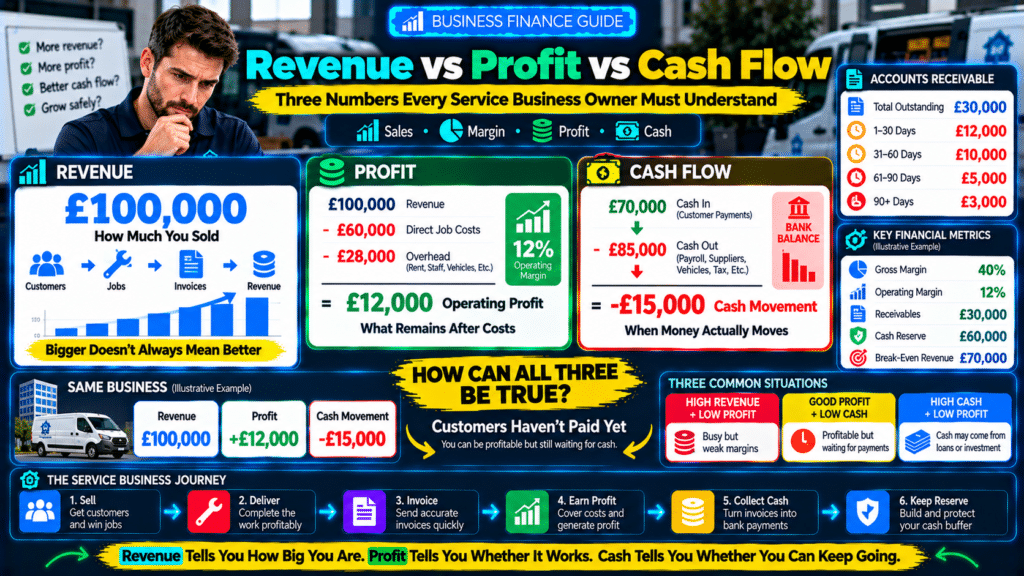
A service business can have:
high revenue
and still make very little profit.
It can have:
good profit
and still struggle to pay payroll.
It can even have:
plenty of cash in the bank
while the underlying business is losing money.
That is because revenue, profit, and cash flow measure three different things.
Understanding the difference is essential for plumbers, electricians, HVAC companies, cleaning businesses, contractors, landscapers, and other service businesses.
A simple way to think about them is:
Revenue = How much the business sells
Profit = How much remains after costs
Cash Flow = When money actually enters and leaves the bank
All three matter.
But they answer different questions.
If you only look at revenue, you can mistake a busy company for a profitable company.
If you only look at profit, you can miss an upcoming cash shortage.
If you only look at the bank balance, you may spend money already needed for tax, payroll, or suppliers.
A stronger financial view looks like:
Revenue
↓
Direct Costs
↓
↓
Overhead
↓
Net / Operating Profit
while separately tracking:
Cash Received
↓
Cash Paid
↓
Closing Bank Balance
Once you understand these relationships, financial decisions become much clearer.
What Is Revenue?
Revenue is the total amount earned from selling your services or products before expenses are deducted.
For a service business, revenue might come from:
- repairs;
- installations;
- maintenance;
- call-out charges;
- recurring service plans;
- materials sold to customers.
Suppose a plumbing company completes:
£80,000
of customer work during a month.
Its revenue is approximately:
£80,000
before considering the costs required to produce that work.
Revenue tells you the size of your sales activity.
It does not tell you how much money you actually kept.
Revenue Example
A contractor completes four projects:
Project A:
£10,000
Project B:
£15,000
Project C:
£20,000
Project D:
£5,000
Total revenue:
£50,000
That sounds good.
But what if the jobs cost:
£45,000
to deliver?
Revenue alone cannot answer whether those projects were worthwhile.
Revenue Is Not the Same as Money in the Bank
This is one of the most common misunderstandings.
Suppose you issue:
£20,000
in invoices this month.
But customers have:
30-day payment terms.
Depending on your accounting method, the business may recognize revenue before the money reaches the bank.
That means:
Revenue: £20,000
does not necessarily mean:
Cash received: £20,000.
This difference becomes especially important for commercial contractors.
What Is Gross Profit?
Gross profit is the amount left after subtracting direct costs associated with delivering the work.
A simplified formula is:
Revenue − Direct Costs = Gross Profit
Direct costs may include:
- technician labor;
- materials;
- subcontractors;
- job-specific equipment;
- disposal;
- other costs directly connected to jobs.
The exact accounting treatment should remain consistent with how your business and accountant classify expenses.
Gross Profit Example
Revenue:
£100,000
Direct job costs:
£60,000
Gross profit:
£40,000
That £40,000 still has to cover:
- office salaries;
- rent;
- software;
- insurance;
- marketing;
- management;
- other overhead.
So gross profit is not necessarily what the owner takes home.
What Is Gross Margin?
Gross margin expresses gross profit as a percentage of revenue.
Formula:
Gross Profit ÷ Revenue × 100
Using the previous example:
£40,000 ÷ £100,000 = 40%
Gross margin:
40%
Gross margin is one of the most useful numbers in a service business because it shows how efficiently revenue turns into money available to cover overhead and profit.
Why Gross Margin Matters More Than Revenue Alone
Consider two businesses.
Business A
Revenue:
£100,000
Gross margin:
25%
Gross profit:
£25,000
Business B
Revenue:
£70,000
Gross margin:
45%
Gross profit:
£31,500
Business A generates:
£30,000 more revenue
but Business B produces:
£6,500 more gross profit.
This is why:
bigger revenue does not automatically mean a healthier business.
What Is Operating Profit?
Operating profit is what remains after the business covers:
- direct costs;
- operating overhead.
For a simplified service-business model:
Gross Profit − Operating Expenses = Operating Profit
Suppose:
Revenue:
£100,000
Direct costs:
£60,000
Gross profit:
£40,000
Operating overhead:
£30,000
Operating profit:
£10,000
The company generated £100,000 of revenue but kept approximately £10,000 in operating profit before other items depending on the accounting structure.
What Is Net Profit?
Net profit is usually the final profit remaining after all relevant expenses have been accounted for.
Depending on your reporting structure, this may include items such as:
- interest;
- taxes;
- non-operating expenses.
The exact presentation varies.
For day-to-day management, service-business owners often focus heavily on:
- gross profit;
- operating profit;
- net profit.
Each tells a different part of the story.
Revenue vs Gross Profit vs Net Profit
Imagine:
Revenue
£100,000
↓
Direct Job Costs
£60,000
↓
Gross Profit
£40,000
↓
Operating Expenses
£28,000
↓
Operating Profit
£12,000
↓
Other relevant expenses
↓
Net Profit
This is why hearing:
We did £100K this month.
does not tell you enough.
The next question should be:
What did we actually keep?
What Is Cash Flow?
Cash flow tracks the actual movement of money into and out of the business.
Cash In
Examples:
- customer payments;
- deposits;
- recurring payments;
- financing proceeds.
Cash Out
Examples:
- payroll;
- materials;
- suppliers;
- vehicles;
- rent;
- tax;
- debt payments.
Cash flow is concerned with timing.
That timing can create major differences between profit and bank balance.
Profit vs Cash Flow Example
Imagine an electrical contractor completes a:
£30,000
commercial project.
Job costs:
£20,000
Expected gross profit:
£10,000
The project appears profitable.
But the customer does not pay for:
60 days.
Meanwhile the contractor already paid:
- wages;
- suppliers;
- fuel;
- subcontractors.
The company may have created profit on paper while experiencing negative cash flow in the short term.
That is why:
profit does not automatically mean cash is available today.
How Can a Profitable Business Run Out of Cash?
Several situations can cause this.
Customers Pay Slowly
Revenue and profit are recorded, but money has not been collected.
Growth Requires Upfront Spending
More work requires:
- materials;
- employees;
- vans.
Cash leaves before new revenue arrives.
Too Much Money Is Tied Up in Inventory
Parts and equipment were purchased but are sitting unused.
Large Tax Payments Become Due
The bank balance looked healthy because tax money had not yet been paid.
Debt Repayments Use Cash
Loan principal payments may affect cash differently from operating profit reporting.
This is why business owners need to monitor both profitability and liquidity.
Can a Business Have Cash but Be Unprofitable?
Yes.
Imagine a company receives:
£100,000 business loan.
Its bank balance rises by:
£100,000.
That does not mean the company made:
£100,000 profit.
The cash came from debt.
Another example:
An owner injects:
£50,000
into the company.
Cash increases.
But operating profitability may still be poor.
A large bank balance does not prove the core business model works.
Revenue vs Cash
Suppose a customer pays:
£10,000 deposit
for work that will happen next month.
Your cash increases today.
But the accounting treatment of that amount as revenue may depend on:
- work completed;
- accounting rules.
This is another example of why:
cash received
and:
revenue earned
are not always identical.
Profit vs Bank Balance
Suppose the business earns:
£15,000 profit
this month.
But it also purchases:
£20,000 equipment
in cash.
The bank balance may decrease even though the business was profitable.
This is why owners should not judge financial health using one number alone.
Think of the Three Numbers as Different Questions
Revenue
How much business are we selling?
Profit
Is the work economically worthwhile?
Cash Flow
Can we pay our obligations when they are due?
All three questions matter.
Example Service Business
Consider a heating company.
Monthly revenue:
£120,000
Direct costs:
£72,000
Gross profit:
£48,000
Operating expenses:
£35,000
Operating profit:
£13,000
Sounds healthy.
But customer collections this month are only:
£90,000
because several commercial invoices are outstanding.
Cash payments this month total:
£105,000
Net cash movement:
−£15,000
So the company can simultaneously have:
£120K revenue
£13K operating profit
and:
negative £15K cash movement.
None of those numbers contradicts the others.
They measure different things.
Why Growing Businesses Often Experience Cash Problems
Growth can consume cash surprisingly quickly.
Imagine increasing sales from:
£60,000
to:
£100,000 per month.
To deliver that extra work, you may need:
- another technician;
- another van;
- more materials;
- more fuel;
- more inventory.
If customers pay after:
30–60 days
you have to fund that growth before receiving the cash.
This creates:
working-capital pressure.
A fast-growing company can therefore experience more cash stress than a smaller company.
Example
Before growth:
Monthly revenue:
£60,000
Materials and payroll paid upfront:
£36,000
After growth:
Monthly revenue:
£100,000
Materials and payroll:
£60,000
You now need an additional:
£24,000
of operating funding before considering other expenses.
If customers have not paid yet, cash becomes tight.
Growth Should Be Forecast, Not Just Celebrated
When sales increase, ask:
- How much working capital will this require?
- When will customers pay?
- Do we need more vehicles?
- Will payroll increase?
- What happens to our cash reserve?
Growth is good only when the business can financially support it.
Revenue Without Profit Is Dangerous
Some businesses chase:
sales volume
at any cost.
For example:
Old revenue:
£70,000
Profit:
£8,000
New revenue:
£100,000
Profit:
£3,000
The company grew by:
£30,000 revenue
but lost:
£5,000 profit.
Possible causes include:
- discounting;
- low-margin projects;
- overtime;
- material increases;
- inefficient jobs.
More work does not automatically create more value.
Profit Without Cash Is Also Dangerous
A profitable company may still struggle because money is trapped in:
- accounts receivable;
- inventory;
- work in progress.
This is why good businesses monitor:
profitability
and:
cash conversion.
What Is Cash Conversion?
Cash conversion describes how effectively business activity eventually turns into actual collected cash.
A typical service journey is:
Lead
↓
Quote
↓
Job Completed
↓
Invoice
↓
Payment
Every delay affects cash.
Example
Slow Process
Job completed:
Day 1.
Invoice sent:
Day 6.
Customer pays:
30 days after invoice.
Cash arrives around:
Day 36.
Improved Process
Job completed:
Day 1.
Invoice sent:
Same day.
Customer pays:
14 days later.
Cash arrives:
Day 15.
The business collects roughly:
three weeks faster.
That can dramatically reduce cash pressure.
How Pricing Affects Revenue, Profit, and Cash
Pricing influences all three metrics.
If you raise prices appropriately:
Revenue
May increase per job.
Gross Profit
May improve.
Cash
May improve because more money is collected from the same number of jobs.
But pricing must still be supported by:
- market demand;
- customer value;
- service quality.
This is why job pricing should be linked to real costs and desired margins.
How Technician Utilization Affects Profit
Suppose you already pay for:
200 technician hours per week.
Only:
120
are productive.
Improving that to:
144 productive hours
may increase revenue without proportionally increasing:
- payroll;
- vehicle count;
- fixed overhead.
That can improve:
- revenue;
- profit;
- cash generation.
Operational efficiency and financial performance are connected.
How No-Shows Affect the Three Metrics
Imagine:
10 no-shows.
Potential sales lost:
£3,000
Revenue opportunity decreases.
Technician wages still get paid.
Profitability suffers.
Cash that could have been collected never arrives.
One operational problem can affect all three financial metrics.
How Callbacks Affect Profit
A callback usually does not create another full-price invoice.
But it still consumes:
- labor;
- fuel;
- parts;
- capacity.
That can reduce gross profit even if revenue remains unchanged.
Tracking callbacks is therefore part of financial management.
How Overhead Affects Profit
Revenue may remain stable while overhead increases.
Example:
Revenue:
£80,000
Gross profit:
£32,000
Overhead before expansion:
£22,000
Profit:
£10,000
After expansion:
Overhead:
£30,000
Profit:
£2,000
Same revenue.
Same gross profit.
Much weaker operating result.
Overhead growth must be managed carefully.
How Hiring Changes the Financial Picture
A new technician may eventually create more revenue.
But initially you may pay for:
- hiring;
- onboarding;
- van;
- tools;
- wages.
before they reach full productivity.
This may temporarily reduce:
profit
and:
cash.
A good hiring decision should consider:
- future capacity;
- break-even increase;
- cash reserve.
How Marketing Affects Revenue, Profit, and Cash
Suppose you spend:
£5,000
on advertising.
It generates:
£20,000 revenue.
Sounds strong.
But jobs generated have:
£12,000 direct costs.
Gross profit:
£8,000
Subtract ad spend:
£5,000
Remaining contribution:
£3,000
The campaign still may be valuable.
But:
£20K revenue from £5K ads
does not tell the full financial story.
Measure:
profit produced by marketing.
How Accounts Receivable Affect Cash
Accounts receivable represents money customers owe you.
Example:
Revenue recognized:
£100,000
Cash collected:
£70,000
Accounts receivable increases by roughly:
£30,000
under a simplified example.
That £30,000 may be profitable work.
But you cannot use it for payroll until the customer pays.
Track Accounts Receivable Aging
Useful categories:
Current
1–30 Days Overdue
31–60 Days
61–90 Days
90+ Days
The older receivables become, the more attention they may require.
How Deposits Improve Cash Flow
Suppose an installation needs:
£6,000 materials.
Without deposit:
business pays:
£6,000
before starting.
With a:
40% deposit
on a £15,000 job:
business collects:
£6,000
before purchasing materials.
The project’s profitability may not change significantly.
But its cash-flow profile improves dramatically.
How Progress Payments Improve Cash Flow
For larger projects:
Deposit
↓
Progress Payment
↓
Final Payment
can reduce the amount of working capital the business must provide.
This is particularly useful for:
- construction;
- installations;
- larger renovation jobs.
Payment structures should always align with applicable laws and contracts.
The Bank Balance Can Mislead You
Suppose your bank shows:
£100,000.
You feel wealthy.
But:
Tax obligation:
£25,000
Next payroll:
£30,000
Suppliers due:
£20,000
Loan payment:
£5,000
Committed cash:
£80,000
Actually flexible cash:
approximately:
£20,000.
That is why financial decisions should not be based solely on today’s bank balance.
Create a Cash Allocation View
A useful internal dashboard can separate:
Bank Cash
into:
- operating cash;
- tax;
- payroll;
- supplier commitments;
- reserve;
- growth capital.
This makes decision-making more disciplined.
Revenue Should Be Tracked by Service
Do not only track total company sales.
Track:
- emergency repairs;
- maintenance;
- installations;
- commercial work.
Some services may create lots of revenue but poor margins.
Others may create smaller invoices with excellent profitability.
Example
Installations
Revenue:
£60,000
Gross margin:
25%
Gross profit:
£15,000
Repairs
Revenue:
£35,000
Gross margin:
50%
Gross profit:
£17,500
Repairs produce:
less revenue
but:
more gross profit.
That insight should influence:
- marketing;
- pricing;
- capacity.
Track Profit by Job
Every significant job should ideally answer:
Quoted Revenue
Actual Labor
Actual Materials
Other Direct Costs
Gross Profit
Gross Margin
Without job-level profitability, you may not know which work is actually helping the business.
Track Revenue per Technician
Suppose:
Monthly company revenue:
£120,000
Six field technicians.
Average revenue per technician:
£20,000
Now compare with:
- productive hours;
- wages;
- gross margin.
This can reveal capacity and pricing issues.
Track Profit per Technician Carefully
Do not turn the metric into a simplistic employee ranking.
Profitability depends on:
- job type;
- territory;
- dispatch;
- sales.
Use it to analyze the system, not automatically blame individuals.
Build a Simple Financial Dashboard
A service-business owner does not need 100 financial metrics.
A useful dashboard might include:
Revenue
Gross Profit
Gross Margin
Operating Profit
Cash Balance
Cash Reserve
Accounts Receivable
Break-Even Revenue
13-Week Lowest Cash Point
This gives a much more complete picture.
Example Dashboard
Monthly Revenue:
£90,000
Gross Profit:
£36,000
Gross Margin:
40%
Operating Profit:
£9,000
Current Cash:
£55,000
Reserve Target:
£60,000
Accounts Receivable:
£42,000
Break-Even Revenue:
£67,500
Now the owner sees:
Revenue is strong
Profit exists
but:
reserve is below target
and:
significant cash is still tied up in receivables.
That is actionable information.
Which Metric Should You Focus On?
The answer is:
all three, for different decisions.
Use Revenue When Asking
- Are sales growing?
- Which services generate the most work?
- How much does each technician produce?
- Are marketing campaigns creating business?
Use Profit When Asking
- Are our prices high enough?
- Are jobs worth doing?
- Is overhead too high?
- Is the company economically healthy?
Use Cash Flow When Asking
- Can we pay payroll?
- Can we afford a van this month?
- What happens if a customer pays late?
- Are we likely to need our reserve?
The numbers complement each other.
A Simple Monthly Finance Review
At the end of each month, review:
Revenue
How much did we sell?
Gross Profit
How much remained after direct costs?
Gross Margin
What percentage did we retain?
Operating Profit
What remained after overhead?
Cash
What is actually in the bank?
Receivables
How much are customers still owing?
Forecast
What happens over the next 13 weeks?
This creates a disciplined financial rhythm.
Use Trends, Not Only One Month
One month can be unusual.
Track:
- current month;
- previous month;
- same month last year;
- rolling quarter;
- rolling 12 months.
This makes it easier to see whether the business is improving.
Example
January
Revenue:
£70K
Profit:
£5K
February
Revenue:
£75K
Profit:
£7K
March
Revenue:
£80K
Profit:
£10K
Now you can see:
both revenue and profitability are improving.
But also check cash.
If receivables are rising quickly:
cash may still be deteriorating.
Common Revenue Mistakes
Celebrating Sales Without Margin
Not all revenue is good revenue.
Chasing Low-Margin Work
More volume can create more stress.
Comparing Revenue Without Service Mix
£100K of installations and £100K of repairs may have very different profitability.
Common Profit Mistakes
Ignoring Owner Labor
A business can appear profitable because the owner works for free.
Ignoring Callbacks
Quality failures reduce real job economics.
Confusing Markup With Margin
This can cause systematic underpricing.
Not Job Costing
You cannot know which jobs are profitable.
Common Cash Flow Mistakes
Assuming Invoices Equal Cash
They do not until collected.
Using Tax Money
Tax liabilities may already claim part of the bank balance.
No Cash Forecast
Problems appear too late.
No Reserve
Small disruptions become emergencies.
The Three-Metric Test Before a Major Decision
Before making a large decision, ask three questions.
Revenue
Will this decision increase or protect sales?
Profit
Will it produce enough margin after costs?
Cash
Can we afford the timing of the investment?
For example:
Hiring a technician
Revenue:
Can they generate enough new work?
Profit:
Will the contribution exceed their true cost?
Cash:
Can we fund:
- van;
- wages;
- onboarding
before the revenue arrives?
That is a much stronger decision process.
The Three-Metric Test for a New Service
Suppose you want to launch:
EV charger installation.
Ask:
Revenue Potential
How much demand exists?
Profit Potential
What margin does each installation create?
Cash Requirement
How much equipment and material must be purchased before the customer pays?
A service can have strong demand and still be financially unattractive if margins or payment terms are poor.
Revenue, Profit, and Cash Flow Checklist
Review whether your business knows:
- Monthly revenue
- Revenue by service
- Gross profit
- Gross margin
- Operating profit
- Profit by major job type
- Current cash
- Cash reserve
- Accounts receivable
- Overdue receivables
- Break-even revenue
- 13-week cash forecast
- Customer payment speed
- Upcoming major cash obligations
If you cannot answer several of these:
your financial dashboard probably needs improvement.
Sources and Further Reading
These official resources back up the methods in this guide and are worth reading alongside it.
- Manage your finances (U.S. Small Business Administration): bookkeeping, financial statements and cash versus accrual accounting.
- Write your business plan (U.S. Small Business Administration): building financial projections and pricing plans.
- Publication 583: Starting a Business and Keeping Records (IRS): recordkeeping basics for small businesses.
Related guides
- How to Calculate Gross Profit Per Job in a Service Business
- How Much Cash Reserve Should a Service Business Keep?
- How to Calculate Break-Even Revenue for a Service Business
- Tools, Software and Automation for Trades: Start Here
Frequently Asked Questions
What is the difference between revenue and profit?
Revenue is the total value of sales.
Profit is what remains after relevant costs are deducted.
A company can have high revenue and low profit.
What is the difference between profit and cash flow?
Profit measures financial performance over a period.
Cash flow tracks the actual movement of money into and out of the business.
A profitable business can still experience negative cash flow.
Can a business have revenue but no cash?
Yes.
A business may complete work and issue invoices before customers have actually paid.
Can a business have cash but no profit?
Yes.
Cash may come from:
- loans;
- owner investment;
- previous periods.
That does not mean current operations are profitable.
What is gross profit?
Gross profit is revenue minus direct costs associated with delivering services or products.
What is gross margin?
Gross margin is:
Gross Profit ÷ Revenue × 100
It shows the percentage of revenue remaining after direct costs.
Is bank balance the same as cash flow?
No.
Bank balance is your cash position at a moment in time.
Cash flow describes the movement of cash over a period.
Which is more important: revenue, profit, or cash flow?
All three are important.
They answer different questions about:
- growth;
- profitability;
- liquidity.
Why do growing companies run out of cash?
Growth often requires upfront spending on:
- employees;
- inventory;
- materials;
- vehicles.
If customers pay later, growth can consume cash before it generates cash.
How often should a service business review these numbers?
At minimum, monthly financial review is useful for many businesses, while cash flow may need weekly monitoring.
Conclusion
Understanding revenue vs profit vs cash flow changes how you look at a service business.
Revenue answers:
How much are we selling?
Profit answers:
How much are we actually earning after costs?
Cash flow answers:
Can we pay our obligations when they become due?
You need all three.
A business can have:
£100K Revenue
but:
£2K Profit
because margins are poor.
A business can have:
£15K Profit
but:
negative cash flow
because customers have not paid yet.
A business can have:
£100K in the bank
but still be unprofitable because the money came from:
- debt;
- investment.
A strong financial system therefore tracks:
Revenue
↓
Gross Profit
↓
Operating Profit
alongside:
Cash In
↓
Cash Out
↓
Cash Balance
↓
Cash Reserve
Then connect those numbers to:
- pricing;
- technician utilization;
- marketing;
- hiring;
- customer payment behavior.
Revenue tells you how much business you are doing.
Profit tells you whether that work creates value.
Cash tells you whether the business can continue operating while waiting for that value to be collected.
A healthy service business needs:
enough revenue
healthy margins
and:
enough cash.
Ignore any one of those three, and the financial picture is incomplete.