
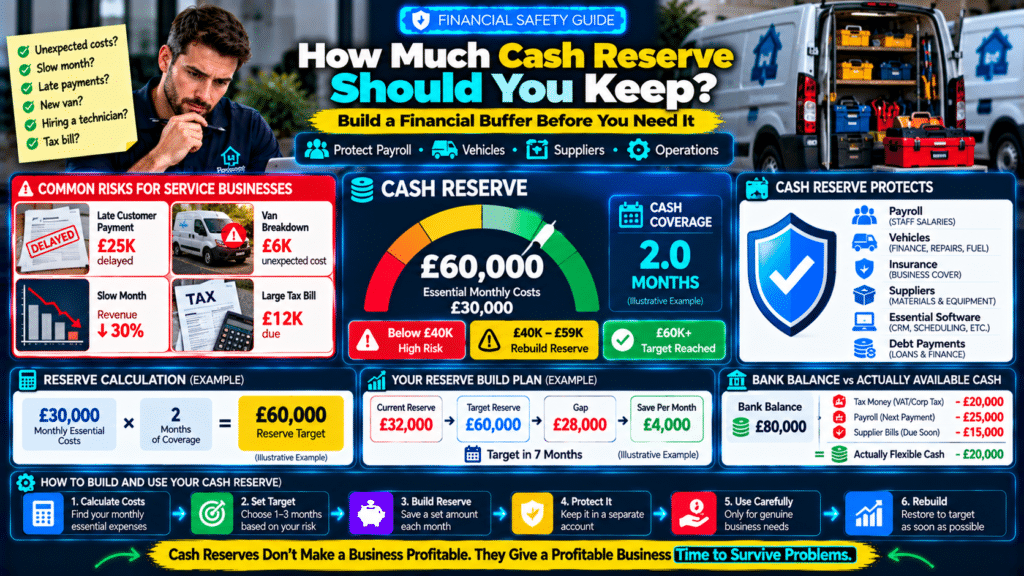
A service business can look healthy right up until something unexpected happens.
A van breaks down.
A large customer pays late.
Weather cancels a week of work.
A major supplier invoice becomes due.
An employee leaves.
A tax payment is larger than expected.
Suddenly the business that looked profitable is asking:
“Do we have enough cash to get through this?”
That is where a cash reserve matters.
A cash reserve is money kept available to protect the business from:
- unexpected costs;
- slow periods;
- delayed customer payments;
- equipment failures;
- temporary revenue drops.
But the important question is not simply:
“Should we keep cash?”
It is:
“How much cash reserve should a service business keep?”
There is no universal number that works for every company.
A better approach is to calculate your reserve based on:
Monthly Essential Expenses
↓
Revenue Stability
↓
Customer Payment Speed
↓
Seasonality
↓
Debt
↓
Operational Risk
↓
Growth Plans
The goal is not to keep every pound sitting in the bank.
The goal is to maintain enough liquidity that one bad month does not immediately become a crisis.
What Is a Business Cash Reserve?
A cash reserve is money intentionally kept available for business needs rather than immediately spent or distributed.
Think of it as:
financial breathing room.
It can help cover expenses when normal cash flow is temporarily interrupted.
For example:
Normal monthly operating expenses:
£35,000
Unexpected payment delay:
£20,000
Without reserve:
The business may struggle to pay:
- wages;
- suppliers;
- vehicles.
With reserve:
The company has time to solve the issue without making rushed decisions.
Cash Reserve vs Normal Bank Balance
These are not necessarily the same thing.
Suppose your bank account contains:
£80,000.
But:
- £20,000 is VAT/tax money;
- £25,000 is needed for payroll;
- £15,000 is required for suppliers.
Only:
£20,000
may actually be available as flexible cash.
Do not assume:
bank balance = reserve.
A reserve should be identified separately in your planning.
Why Service Businesses Need Cash Reserves
Service companies often have uneven cash flows.
Revenue can be affected by:
- weather;
- seasonality;
- customer payment terms;
- emergency repairs;
- staffing.
Meanwhile many expenses continue regardless of workload.
You may still need to pay:
- office staff;
- vehicle finance;
- insurance;
- software;
- rent;
- salaries.
That is why even profitable businesses need liquidity.
Cash Reserve vs Cash Flow Forecast
These two work together.
Cash Flow Forecast
Answers:
What do we expect our cash balance to be over the next several weeks?
Cash Reserve
Answers:
How much cash do we intentionally want available as protection?
A 13-week forecast can show:
when the reserve might be needed.
The reserve gives you:
something to fall back on.
A Common Starting Point: Months of Essential Expenses
A simple way to think about reserves is:
Cash Reserve = Essential Monthly Operating Costs × Number of Months
For example:
Essential monthly costs:
£30,000
Target:
2 months
Reserve target:
£60,000
If the business targets:
3 months
reserve:
£90,000
The correct number depends on the company.
Why There Is No Universal Reserve Number
Two businesses with the same revenue can need very different reserves.
Business A
- Mostly residential customers
- Paid immediately
- Low debt
- Stable recurring demand
Business B
- Commercial customers
- 60-day payment terms
- High vehicle finance
- Seasonal work
Business B probably needs more financial protection.
The reserve should reflect risk.
Step 1: Calculate Essential Monthly Expenses
Do not start with revenue.
Start with:
What does the business need to survive one month?
Essential costs may include:
- payroll;
- rent;
- vehicle payments;
- insurance;
- essential software;
- loan payments;
- utilities;
- minimum supplier commitments.
Example
| Essential Expense | Monthly Cost |
|---|---|
| Payroll | £18,000 |
| Vehicles | £4,000 |
| Rent / Storage | £2,000 |
| Insurance | £1,500 |
| Software | £1,000 |
| Utilities / Phones | £700 |
| Loan Payments | £1,800 |
Total:
£29,000/month
This is your baseline.
Step 2: Separate Essential From Optional Spending
Not every cost needs to be protected equally.
Essential
- payroll;
- rent;
- insurance;
- debt commitments;
- critical software.
More Flexible
- optional equipment upgrade;
- discretionary marketing expansion;
- office refurbishment.
During a crisis, optional expenses may be delayed.
That is why reserve calculations should focus heavily on:
core operating commitments.
Step 3: Decide How Many Months of Protection You Need
A lower-risk company may be comfortable with:
1–2 months
of essential operating expenses.
A business with more uncertainty may aim for:
3 months or more.
The right amount depends on several factors.
Factor 1: Revenue Stability
Ask:
How predictable is revenue?
More Stable
Examples:
- recurring cleaning;
- maintenance contracts;
- subscription-like service plans.
Less Stable
Examples:
- one-off construction;
- emergency projects;
- seasonal landscaping.
More volatile revenue generally justifies a larger buffer.
Factor 2: Customer Payment Terms
Residential customers often pay:
- immediately;
- within a few days.
Commercial customers may pay:
- 30 days;
- 60 days;
- longer.
Longer payment cycles increase cash-flow risk.
If customers regularly pay slowly, your reserve may need to be larger.
Factor 3: Customer Concentration
Ask:
How much of our revenue comes from our biggest customer?
Suppose one commercial customer represents:
35% of monthly revenue.
If that customer pays late:
the business may immediately feel pressure.
High customer concentration increases reserve needs.
Factor 4: Seasonality
Some businesses experience predictable slow periods.
Landscaping
Winter may be weaker.
HVAC
Spring or autumn may be slower than extreme weather periods.
Roofing
Weather may interrupt production.
If you know revenue drops seasonally:
build reserve during stronger months.
Factor 5: Debt
Businesses with large fixed debt commitments have less flexibility.
Examples:
- van finance;
- equipment loans;
- office lease.
If revenue drops:
those payments still exist.
Higher fixed obligations usually justify stronger reserves.
Factor 6: Payroll
A labor-heavy business may need more cash protection.
Payroll happens on schedule.
Employees cannot wait because:
Customers paid late this month.
A company with:
£30,000 payroll every month
has greater short-term cash pressure than a solo operator.
Factor 7: Equipment Risk
Some businesses depend on expensive assets.
Examples:
- vans;
- machinery;
- specialist equipment.
If a critical machine fails:
replacement may cost:
£5,000
or:
£20,000+.
Reserve planning should consider major operational risks.
Factor 8: Growth Plans
Growth often consumes cash.
Hiring may require:
- salary;
- vehicle;
- tools;
- training.
Before revenue from the new employee fully arrives.
A reserve can help support growth safely.
But do not use your entire emergency reserve to fund expansion.
Build Two Cash Targets
It can help to think in two layers.
Operating Reserve
Cash for normal unexpected disruption.
Strategic Cash
Money intentionally saved for:
- new vehicle;
- hiring;
- expansion.
Do not confuse:
emergency money
with:
planned investment money.
Example
Operating reserve:
£60,000
Vehicle fund:
£20,000
Expansion fund:
£15,000
Total cash target:
£95,000
But only:
£60,000
is considered the emergency reserve.
What Should a Cash Reserve Cover?
Ideally, reserve money protects critical obligations such as:
- payroll;
- insurance;
- rent;
- vehicle payments;
- essential suppliers;
- loan obligations;
- emergency repairs.
It is not intended primarily for:
- random purchases;
- unnecessary upgrades;
- owner withdrawals.
Scenario 1: Large Customer Pays Late
Outstanding payment:
£25,000
Expected:
Week 1.
Actual:
Week 5.
Meanwhile:
Payroll:
£15,000
Suppliers:
£8,000
A reserve gives the company time without immediately relying on expensive emergency financing.
Scenario 2: Van Failure
Transmission repair:
£4,500
or replacement deposit:
£8,000
Without reserve:
the company may delay jobs.
With reserve:
operations continue.
Scenario 3: Weather Disruption
Roofing company loses:
7 working days
due to weather.
Revenue falls.
But:
- payroll;
- vehicle costs;
- insurance
continue.
Reserve helps bridge the gap.
Scenario 4: Unexpected Tax Payment
The business discovers tax due is:
£12,000 higher than expected.
If all bank cash has already been spent:
serious pressure follows.
Better tax planning plus reserve reduces the risk.
Do Not Use Tax Money as Your Reserve
If money belongs to future tax obligations:
do not mentally count it as emergency cash.
Where practical, separate:
tax funds
from:
operating reserve.
This gives you a more accurate view.
Build a Reserve Using Percentages
Another approach is to automatically move a percentage of incoming cash.
For example:
5% of collections
goes to reserve.
If monthly collections are:
£80,000
reserve contribution:
£4,000/month.
This can gradually build the buffer.
Example
Starting reserve:
£15,000
Monthly contribution:
£4,000
After 12 months:
Approximately:
£63,000
assuming no withdrawals and simplified calculations.
Small consistent contributions can build meaningful protection.
Use a Separate Reserve Account
Some owners find it helpful to keep reserves in a separate business account.
Benefits:
- easier to track;
- less temptation to spend;
- clearer reporting.
It should still remain sufficiently liquid for genuine emergencies.
Reserve Money Should Be Accessible
An emergency reserve should not be locked somewhere that takes:
six months
to access.
The point is liquidity.
The exact account type depends on:
- country;
- banking options;
- risk tolerance.
Business owners should consider professional financial advice where appropriate.
But Do Not Leave Excessive Cash Idle Without a Reason
There is also a cost to holding too much cash.
Money sitting unused may otherwise support:
- growth;
- debt reduction;
- equipment;
- owner returns.
The goal is:
appropriate liquidity
not:
maximum bank balance.
Reserve Target Example
Suppose essential monthly operating costs are:
£32,000
Business characteristics:
- some recurring revenue;
- moderate seasonality;
- mostly residential customers;
- low customer concentration.
Owner decides target:
2 months
Reserve:
£64,000
That may be reasonable for their risk profile.
Another business with:
- 60-day commercial terms;
- highly seasonal work;
- expensive equipment
might choose a larger target.
Low-Risk Example
Essential monthly expenses:
£20,000
Stable recurring contracts.
Customers pay quickly.
Low debt.
Target:
1.5 months
Reserve:
£30,000
Higher-Risk Example
Essential monthly expenses:
£45,000
Seasonal business.
Commercial payment terms.
Large equipment costs.
Target:
3 months
Reserve:
£135,000
These are illustrative examples, not universal recommendations.
Use Your 13-Week Forecast to Test the Reserve
Suppose reserve target is:
£60,000.
Your cash-flow forecast shows:
Week 8 balance drops to:
£38,000.
That means reserve would be used.
Ask:
- why is cash falling?
- is it temporary?
- can the cause be fixed?
Reserve should not hide a permanently unprofitable operation.
A Reserve Is Not a Substitute for Profit
If the business loses:
£10,000 every month
a:
£60,000 reserve
only delays the problem by:
six months.
The underlying issue still needs fixing.
Possible causes:
- pricing too low;
- overhead too high;
- weak utilization;
- poor collections.
Reserve protects healthy businesses from temporary shocks.
It does not fix broken economics.
Reserve Is Not a Substitute for Credit Control
If customers regularly owe:
£100,000 overdue
you may have a collection problem.
Do not simply increase reserve forever.
Improve:
- invoice speed;
- payment terms;
- reminders;
- deposits;
- progress billing.
Cash management should address root causes.
Reserve Is Not a Substitute for Insurance
Cash can help with unexpected losses.
But major risks may require proper insurance.
Examples:
- vehicle accidents;
- property damage;
- liability.
A reserve and insurance serve different purposes.
When Should You Use the Reserve?
Possible legitimate reasons include:
- temporary revenue drop;
- critical equipment failure;
- delayed customer payment;
- emergency business expense;
- short-term operating disruption.
When Should You Avoid Using It?
Generally avoid using the emergency reserve for:
- routine overspending;
- unnecessary upgrades;
- owner lifestyle withdrawals;
- recurring losses.
If you keep dipping into reserve for normal operations:
that is a warning.
Create Reserve Rules
Write a simple policy.
For example:
Reserve Target: £60,000
Minimum Level: £40,000
Use Requires: Director approval
Approved Uses:
- payroll protection;
- major equipment failure;
- temporary cash shortfall.
Rebuild Rule:
10% of monthly free cash flow until target restored.
This creates discipline.
Use Green, Yellow, Red Reserve Zones
Example:
Green
£60,000+
Target achieved.
Yellow
£40,000–£59,999
Rebuild.
Red
Below £40,000
Restrict discretionary spending and review cash immediately.
Thresholds should be designed for your company.
Rebuild the Reserve After Using It
Suppose reserve drops from:
£60,000
to:
£42,000
after a difficult month.
Do not simply accept:
£42,000 is the new normal.
Create a rebuild plan.
For example:
- £3,000/month;
- percentage of profit;
- percentage of collections.
Until target is restored.
Cash Reserve and Break-Even
Your break-even number helps estimate how expensive the business is to operate.
Suppose break-even revenue is:
£50,000/month.
But essential cash costs are:
£30,000/month.
Reserve planning should usually focus on:
cash obligations
not the full break-even sales number.
The two metrics work together but measure different things.
Cash Reserve and Technician Hiring
Before hiring:
ask:
What happens to our reserve if revenue takes three months to catch up?
For example:
Current reserve:
£70,000
Hiring investment:
- van deposit £8,000;
- tools £4,000;
- onboarding £2,000.
Initial cash outflow:
£14,000
Reserve remaining:
£56,000
Is that still above your safe level?
This helps prevent overexpansion.
Cash Reserve and Vehicle Purchases
A service company may see:
£80,000 cash
and think:
We can buy two vans.
But if reserve target is:
£60,000
only:
£20,000
may be strategically available.
That changes the decision.
Cash Reserve and Marketing
Marketing often takes time to generate returns.
If you increase marketing spend:
do not fund it by destroying emergency liquidity.
Budget growth investment separately.
Cash Reserve and Seasonal Businesses
A seasonal company should build cash during strong periods.
Example:
Summer
Strong cash generation.
Winter
Lower revenue.
Reserve plan:
build May–September
↓
use carefully October–February
This can smooth the year.
Create a Seasonal Reserve Forecast
Example:
Peak-season reserve:
£100,000
Expected winter drawdown:
£35,000
Minimum safe reserve:
£50,000
Forecast winter closing:
£65,000
This suggests adequate protection.
Watch Customer Concentration
Suppose total monthly revenue:
£100,000
One customer:
£40,000
If they stop buying or pay 60 days late:
huge cash impact.
A concentrated customer base generally increases financial risk.
A larger reserve may be appropriate while you diversify.
Watch Supplier Concentration Too
If one supplier provides most critical materials and suddenly requires:
- upfront payment;
- shorter terms;
cash requirements can change quickly.
Reserve planning should consider supplier risk.
Create a Reserve Dashboard
Useful metrics:
Current Reserve: £58,000
Target Reserve: £75,000
Minimum Level: £50,000
Essential Monthly Costs: £30,000
Months Covered: 1.93
Status: Yellow
Now the owner instantly understands the position.
Calculate Months of Cash Coverage
Formula:
Available Reserve ÷ Essential Monthly Expenses
Example:
Reserve:
£60,000
Essential expenses:
£30,000/month
Coverage:
2 months
This metric is easy to monitor.
Calculate Reserve Gap
Formula:
Target Reserve − Current Reserve
Example:
Target:
£90,000
Current:
£62,000
Gap:
£28,000
Now you can build a plan.
Example Reserve Build Plan
Gap:
£28,000
Monthly contribution:
£4,000
Time required:
approximately:
7 months
This turns:
We need more cash.
into:
a measurable objective.
Review the Reserve Quarterly
Business conditions change.
Review your reserve target after:
- hiring;
- new debt;
- new location;
- major equipment purchases;
- changes in customer terms.
A £40,000 reserve may have been enough when you had:
2 technicians.
It may be too small with:
8 technicians.
Review After Major Growth
If monthly payroll grows from:
£15,000
to:
£35,000
your reserve target probably needs updating.
Growth increases:
- opportunity;
- risk;
- cash requirements.
Common Cash Reserve Mistakes
Keeping No Reserve
One unexpected event can create crisis.
Counting Tax Money
That money may already be committed.
Using the Reserve for Routine Expenses
A reserve should not hide weak operations.
No Target
“We keep whatever is left” is not a strategy.
Holding Too Little After Growth
Expenses increase as the company scales.
No Rebuild Plan
Reserve gets used and never restored.
Keeping Too Much Without Purpose
Cash should have a reason.
Treating Credit as Reserve
An unused credit facility is not the same as cash.
No Forecast
You cannot see upcoming pressure.
Ignoring Customer Payment Risk
Receivables are not cash.
Cash Reserve Checklist
Review:
- Essential monthly costs calculated
- Tax cash separated where appropriate
- Reserve target defined
- Minimum threshold defined
- Months of coverage calculated
- Customer concentration reviewed
- Seasonality considered
- Debt obligations considered
- Equipment risk considered
- Reserve account separated
- Use policy documented
- Rebuild process defined
- Target reviewed quarterly
- 13-week cash forecast maintained
Sources and Further Reading
These official resources back up the methods in this guide and are worth reading alongside it.
- Manage your finances (U.S. Small Business Administration): bookkeeping, financial statements and cash versus accrual accounting.
- Write your business plan (U.S. Small Business Administration): building financial projections and pricing plans.
Related guides
- Revenue vs Profit vs Cash Flow: What Service Business Owners Need to Know
- How to Improve Gross Margin in a Service Business Without Just Raising Prices
- How to Calculate Gross Profit Per Job in a Service Business
- Tools, Software and Automation for Trades: Start Here
Frequently Asked Questions
How much cash reserve should a service business keep?
There is no universal amount.
A practical approach is to calculate:
essential monthly operating costs
and hold a chosen number of months based on:
- revenue stability;
- seasonality;
- customer payment speed;
- debt;
- business risk.
Is three months of expenses enough?
It may be suitable for some businesses and excessive or insufficient for others.
The right reserve depends on your company’s risk profile.
What expenses should a reserve cover?
Focus on critical obligations such as:
- payroll;
- rent;
- insurance;
- essential software;
- vehicle payments;
- debt obligations.
Should tax money count toward my reserve?
Usually, money already expected to cover tax obligations should not be treated as freely available emergency cash.
Should a reserve be kept in a separate account?
Many owners find this useful because it improves:
- visibility;
- discipline.
Can I use my cash reserve to buy a van?
You can technically use cash however you choose, but an emergency reserve should generally remain protected.
Planned capital purchases are better funded separately where practical.
What if my business keeps using the reserve?
Repeated reserve use for normal operating expenses can indicate deeper problems such as:
- weak pricing;
- poor collections;
- excessive overhead.
How do I calculate months of cash coverage?
Use:
Cash Reserve ÷ Essential Monthly Expenses
For example:
£60,000 ÷ £30,000 =
2 months.
Should growing businesses keep more reserve?
Often growth increases cash requirements because of:
- hiring;
- vehicles;
- payroll;
- inventory.
The reserve target should be reviewed as the company grows.
Is a line of credit the same as a cash reserve?
No.
Credit may provide additional liquidity, but it creates debt and can be subject to lender conditions.
Actual cash reserve is different.
Conclusion
So, how much cash reserve should a service business keep?
There is no magic number.
Start with:
Essential Monthly Expenses
↓
Risk Level
↓
Months of Protection
↓
Reserve Target
For example:
Essential monthly costs:
£30,000
Target:
2 months
Reserve:
£60,000
But another company may need more because it has:
- seasonal revenue;
- slow-paying commercial customers;
- expensive equipment;
- large payroll.
Your reserve should reflect:
how vulnerable the business is to disruption.
Build it intentionally.
Protect it.
Use it when genuinely necessary.
Then rebuild it.
The strongest financial structure combines:
Healthy Profit
13-Week Cash Forecast
Cash Reserve
Profit helps the business grow.
Forecasting helps you see problems coming.
The reserve gives you time to solve those problems without panic.
A service business does not need unlimited cash sitting idle.
It needs enough liquidity so one:
- late payment;
- broken van;
- slow month;
- unexpected bill
does not immediately threaten:
payroll, suppliers, and operations.
That is what a good cash reserve is really for.



1 thought on “How Much Cash Reserve Should a Service Business Keep?”
Pingback: How to Know If Your Service Business Can Afford Another Technician