hey did a great job for me.”
That recommendation already carries something most marketing campaigns have to work hard to create:
trust.
A homeowner is more likely to call a plumber recommended by a neighbor.
A business owner may feel more comfortable hiring an electrician referred by another company.
A customer looking for a cleaner may choose the business their friend already uses.
This is why a well-designed customer referral program for a service business can become a powerful growth channel.
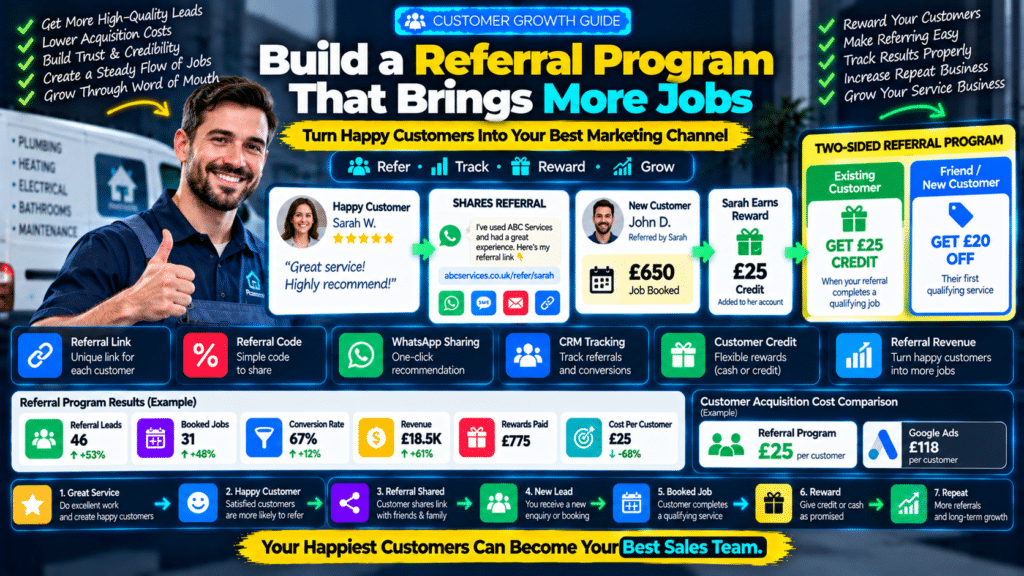
The process is simple:
Great Service
↓
Happy Customer
↓
Referral Request
↓
Customer Shares
↓
New Lead
↓
Booked Job
↓
Reward Delivered
The difficult part is making that process:
- easy;
- consistent;
- measurable;
- worthwhile.
A referral program should not feel like a complicated loyalty scheme.
For many local service businesses, a simple offer and a clear process can be enough.
What Is a Customer Referral Program?
A customer referral program encourages existing customers to recommend your business to:
- friends;
- family;
- neighbors;
- colleagues;
- other businesses.
When the referred person becomes a customer, the person who referred them may receive a reward.
For example:
Refer a friend who books a qualifying service and receive £25 credit toward your next visit.
Another model might reward both customers:
Give a friend £20 off their first service and receive £20 credit after their job is completed.
The exact structure depends on your:
- industry;
- margins;
- average job value;
- customer frequency.
Referral Program vs Normal Word of Mouth
Word of mouth already happens naturally.
A referral program makes it more deliberate.
Normal Word of Mouth
Customer remembers your company.
↓
Friend asks for recommendation.
↓
Customer gives your number.
Referral Program
Customer completes a job.
↓
You actively invite them to refer someone.
↓
You provide an easy referral method.
↓
Referral is tracked.
↓
Reward is issued.
The second approach creates a repeatable system.
Why Referrals Can Be Valuable
Referral leads often arrive with more trust than completely cold leads.
The potential customer may already know:
- you showed up;
- your work was good;
- the experience was professional.
The existing customer has already done part of the selling for you.
This can reduce friction during:
- enquiry;
- quote;
- booking.
Start With Great Service
No referral program can compensate for poor service.
Customers recommend businesses when they feel confident putting their own reputation behind the recommendation.
Before building a program, ask:
- Do we arrive when promised?
- Do we communicate clearly?
- Is the work consistently good?
- Do customers trust our staff?
- Do we handle problems professionally?
- Are customers already recommending us informally?
If customers are unhappy, offering them £20 to recommend someone is unlikely to fix the underlying issue.
The strongest referral strategy begins with:
a service worth recommending.
Step 1: Decide What You Want the Program to Achieve
Do not create a referral program simply because other companies have one.
Choose a clear goal.
Possible goals include:
More New Customers
The most common goal.
More High-Value Jobs
For example:
- boiler installations;
- rewires;
- roofing projects;
- landscaping projects.
More Recurring Customers
Useful for:
- cleaning;
- lawn care;
- pest control;
- pool service.
Expansion Into a New Area
Existing customers may know friends or family in nearby locations.
More Commercial Clients
A B2B referral program may encourage:
- landlords;
- property managers;
- estate agents;
- contractors
to refer suitable customers.
Your goal affects the reward structure.
Step 2: Understand Your Average Job Value
Before deciding how much to give away, know what a new customer is worth.
Suppose your average booked job is:
£400
and your gross profit from that job is:
£160.
A:
£20 referral reward
may be easy to justify.
But if your average service is only:
£40
a £20 reward may destroy too much margin.
The reward should make economic sense.
Referral Cost Example
Suppose you offer:
£25 customer credit
for every successful referral.
Ten successful referrals cost:
£250
If those referrals generate:
£5,000 revenue
the program may be attractive.
But do not evaluate only revenue.
Consider:
- gross profit;
- reward cost;
- administrative cost;
- repeat customer value.
Calculate Cost Per Referred Customer
A simple formula is:
Total Referral Rewards ÷ New Referred Customers
Example:
Rewards issued:
£500
New customers:
20
Cost per referred customer:
£25
You can compare this with:
- Google Ads cost per booked job;
- Facebook acquisition cost;
- other marketing channels.
Step 3: Choose the Referral Reward
There are several ways to structure the incentive.
Option 1: Account Credit
Example:
Receive £25 credit toward your next service.
This works particularly well for recurring businesses such as:
- cleaning;
- landscaping;
- pest control;
- pool service;
- HVAC maintenance.
The customer has a reason to return.
Option 2: Cash Reward
Example:
Receive £30 after your referral completes their first qualifying job.
This can work for businesses where customers do not need the service often.
For example:
- roofing;
- major electrical projects;
- removals.
A customer may not want future credit if they do not expect to need the company again soon.
Option 3: Gift Card
Example:
Receive a £25 gift card when your referral becomes a customer.
Gift cards can feel more tangible than account credit.
But they create:
- fulfillment;
- tracking;
- administrative work.
Option 4: Reward Both Customers
This is often called a two-sided referral program.
Example:
Existing Customer
Gets:
£25 credit
New Customer
Gets:
£25 off first qualifying service
This gives both people a reason to participate.
Option 5: Service Upgrade
Instead of money, offer something relevant to the service.
Example for a cleaning company:
Refer a friend and receive a free oven clean with your next qualifying visit.
Example for landscaping:
Refer a neighbor and receive a complimentary seasonal treatment.
The reward should have clear value without creating excessive cost.
Which Referral Reward Is Best?
There is no universal answer.
A useful rule is:
Recurring Business
Consider:
account credit.
One-Time / Infrequent Service
Consider:
cash or gift card.
High-Margin Service
You may have room for a stronger reward.
Low-Ticket Service
Keep the reward smaller or require a minimum job value.
Set a Minimum Qualifying Job Value
You do not want to pay:
£50
for a referral that produces:
£35 revenue.
Set a clear qualification rule.
For example:
Referral reward applies when the new customer’s completed job is worth at least £200.
Or:
Reward is issued after the referred customer completes their first paid service.
This protects the economics of the program.
Step 4: Define Exactly When a Referral Counts
Avoid vague rules.
Does the reward apply when:
- someone submits a form?
- requests a quote?
- books?
- pays?
The cleanest trigger is usually:
successful paid job.
For example:
A referral qualifies once the new customer completes and pays for a qualifying service.
This avoids paying for:
- spam leads;
- cancelled appointments;
- quotes that never convert.
Example Referral Journey
John refers Sarah
↓
Sarah requests quote.
↓
Sarah books £650 job.
↓
Job completed.
↓
Invoice paid.
↓
John receives £25 credit.
That is simple to understand.
Step 5: Make Referring Someone Easy
A referral program fails when customers have to work too hard.
Do not require them to:
- download a PDF;
- fill in five fields;
- create an account;
- remember a complicated code.
The referral process should ideally take less than a minute.
Easy Referral Methods
Unique Referral Link
Example:
yourcompany.com/refer/john
Referral Code
Example:
JOHN25
Simple Form
Customer enters:
- their name;
- friend’s name;
- friend’s contact information with appropriate consent.
Share Button
Provide:
- WhatsApp;
- SMS;
- email.
For many local service businesses, a simple referral link plus WhatsApp sharing can work well.
Example Referral Message
Give customers something easy to send:
I’ve used ABC Plumbing and had a good experience. If you need a plumber, here’s their referral link: [link]
Do not make customers write the marketing copy themselves.
Step 6: Ask at the Right Time
Timing matters.
A poor time to ask for a referral is:
before you have completed the job.
A much better moment is when the customer is satisfied.
Examples:
Immediately After Successful Completion
Technician has finished.
Customer is happy.
After Positive Feedback
Customer says:
Great work, thank you.
That is a natural opportunity.
After a Positive Review
A customer who just left a strong review may be more willing to recommend the business.
During a Repeat Visit
A long-term customer already knows the quality of your service.
Example Technician Script
Keep it natural:
We’re glad you’re happy with the work. We also have a referral program—if you recommend us to someone who books a qualifying job, you’ll receive £25 credit toward your next service. I’ll text you the link.
No pressure.
No long sales pitch.
Step 7: Promote the Program in Multiple Places
Do not expect customers to remember a referral program they heard about once.
Mention it naturally in places such as:
- invoice email;
- completion email;
- customer portal;
- website;
- SMS follow-up;
- newsletter.
Website Referral Page
Create a simple page:
Refer a Friend
Explain:
- reward;
- qualification;
- how to share;
- when rewards are issued;
- terms.
Keep it simple.
Example Referral Page Structure
Refer a Friend & Earn £25 Credit
Love our service?
Recommend us to someone you know.
How It Works
1. Share Your Link
Send your referral link to a friend.
2. They Book
They complete a qualifying service.
3. You Get Rewarded
Receive £25 credit toward your next service.
Terms
Short, clear eligibility conditions.
Add the Program to Completion Messages
After a job:
Thanks for choosing ABC Electrical. If you know someone who could use our help, refer them here: [link]. You’ll receive £25 credit after their qualifying job is completed.
This turns every successfully completed job into a possible referral opportunity.
Do Not Ask Constantly
Referral marketing can become annoying if customers receive:
- referral SMS after every visit;
- referral email every week;
- popup every time they open the website.
A useful cadence might be:
after a successful job
and perhaps:
occasional reminder to existing customers.
Do not overdo it.
Step 8: Track Referrals Properly
If you cannot track who referred whom, the program will become difficult to manage.
At minimum, record:
- referrer;
- referred customer;
- referral date;
- job status;
- job value;
- reward status.
Example CRM Record
Referrer:
John Smith
Referred Customer:
Sarah Williams
Service:
Boiler Repair
Job Value:
£650
Status:
Completed & Paid
Reward:
£25 Credit
Reward Status:
Issued
This removes ambiguity.
Use Referral Codes
Codes are easy to understand.
Example:
JOHN25
The new customer enters the code during:
- booking;
- quote request.
Then your system stores:
Referral Source = JOHN25
Use Referral Links
Links can be even easier.
For example:
abcplumbing.com/refer/12345
The link can automatically associate the visitor with:
Customer 12345
This reduces manual entry.
Train Office Staff to Record Referrals
Not every referral will arrive through a link.
A customer may call and say:
My neighbor John recommended you.
The office team should record:
Lead Source: Referral
and:
Referred By: John Smith
Do not let those leads disappear into:
Other.
Step 9: Prevent Referral Fraud
Any reward program can be abused.
Potential problems include:
- people referring themselves;
- fake accounts;
- duplicate claims;
- unpaid jobs;
- employees creating fake referrals.
Create basic rules.
Example Rules
- New customer must not already exist in the CRM.
- Reward applies only after payment.
- One reward per new customer.
- Referral cannot be self-referral.
- Minimum qualifying job value applies.
- Reward has no cash value if using service credit.
You do not need a 20-page legal document.
But the rules should be clear.
What About Employee Referrals?
You can run a separate employee referral program.
For example:
Team member receives £30 for each new customer they personally refer who completes a qualifying job.
Keep employee and customer programs separate in reporting so you understand where business comes from.
Partner Referral Programs
Service businesses can also generate referrals from complementary companies.
Examples:
Plumber
Partner with:
- electricians;
- builders;
- property managers.
Electrician
Partner with:
- solar installers;
- builders;
- estate agents.
Removals Company
Partner with:
- estate agents;
- storage companies;
- cleaning companies.
Cleaning Business
Partner with:
- property managers;
- estate agents;
- Airbnb hosts.
This is more B2B than customer referral marketing, but the same principle applies.
Avoid Referral Conflicts
Do not recommend poor companies simply because they pay referral commissions.
Your recommendation affects your own reputation.
Partners should be:
- reliable;
- professional;
- relevant.
Referral Programs for Plumbers
A plumbing referral program might offer:
Refer a friend who completes a job over £200 and receive £25 credit toward your next plumbing or heating service.
This works well because customers may return for:
- servicing;
- repairs;
- maintenance.
Referral Programs for HVAC
HVAC businesses can tie rewards to recurring maintenance.
For example:
Refer a friend and receive £30 toward your next annual maintenance visit.
That supports both:
- acquisition;
- retention.
Referral Programs for Electricians
Electrical customers may not need regular service frequently.
A gift card or cash reward may therefore be more attractive than future credit.
Example:
Refer a customer who completes a qualifying installation and receive a £30 gift card.
Referral Programs for Cleaning Businesses
Cleaning is ideal for account-credit referrals.
For example:
Give a friend £20 off their first clean. Get £20 credit after their first completed appointment.
Because customers often book repeatedly, the credit encourages retention.
Referral Programs for Landscaping
A landscaper could offer:
Refer a neighbor who books a qualifying project and receive £40 credit toward your next maintenance or landscaping service.
Neighborhood-based referrals can be especially powerful because nearby homeowners often see the work.
Referral Programs for Contractors
For high-ticket construction projects, the reward can be larger.
But the qualification should also be stronger.
Example:
Receive a £150 referral reward after a referred customer completes a qualifying project worth £5,000 or more.
Always ensure the reward makes financial sense for your business and complies with applicable rules and contracts.
Referral Program vs Discounting
A referral reward is different from simply discounting everyone.
A normal discount says:
Pay us less.
A referral program says:
Help us acquire a customer and we’ll share some of that acquisition value with you.
That can be more strategic.
Do Not Destroy Margin With Rewards
Suppose your average gross profit per new job is:
£80.
Offering:
£75 to the existing customer
plus:
£50 to the new customer
means the acquisition already costs:
£125
before administration.
That does not make sense unless the customer has strong lifetime value.
Use real numbers.
Compare Referral Acquisition Cost With Ads
Suppose:
Google Ads
Average cost per booked job:
£120
Referral Program
Average reward cost per booked job:
£30
If referral customers also convert more easily, the referral program may be one of your best acquisition channels.
This is why tracking matters.
Measure Referral Conversion Rate
Formula:
Referred Customers Who Book ÷ Referral Leads × 100
Example:
40 referral enquiries.
30 book.
Conversion rate:
75%.
Compare that against:
- paid search;
- organic search;
- social media.
Measure Referral Revenue
Track:
Revenue from referred customers.
For example:
Referral customers this quarter:
25
Revenue:
£18,500
Rewards issued:
£750
Now you have real business data.
Measure Customer Lifetime Value
A referred cleaning customer may book:
twice per month
for years.
The first appointment value does not tell the whole story.
Track:
initial revenue
and:
long-term revenue
where possible.
This is especially important for:
- cleaning;
- lawn care;
- pest control;
- pool service;
- maintenance plans.
Track Who Your Best Referrers Are
You may discover that a small number of customers generate many referrals.
For example:
Sarah
6 successful referrals.
John
Emma
These customers are valuable advocates.
You may want to:
- thank them personally;
- provide extra recognition;
- invite them into a VIP referral tier.
Referral Tiers
Once the program is established, you could create tiers.
For example:
1 Successful Referral
£20 credit.
3 Successful Referrals
£75 total bonus.
5 Successful Referrals
£150 total bonus.
This can encourage repeat advocacy.
Do not add tiers until the basic program works.
Complexity should come later.
Referral Program Automation
Once you have enough volume, automate parts of the process.
Example:
Job Completed
↓
Wait 1 day.
↓
Send referral invitation.
↓
Customer shares link.
↓
New lead enters CRM.
↓
Referral recorded.
↓
New job completed and paid.
↓
Reward created.
↓
Referrer notified.
Automation should reduce administration while keeping the customer experience understandable.
Example Referral SMS
Hi Sarah, thanks again for choosing ABC Plumbing. If you know someone who needs a reliable plumber, you can refer them here: [link]. You’ll receive £25 credit after their qualifying job is completed.
Short.
Clear.
Useful.
Example Referral Email
Subject: Know Someone Who Needs Our Help?
Thanks for choosing ABC Electrical. If a friend, neighbor or colleague needs electrical work, we’d be grateful for the recommendation.
Share your personal referral link below. When your referral completes a qualifying service, you’ll receive £30 credit toward a future booking.
[Share Your Referral Link]
Then explain basic terms underneath.
Customer Referral Program Mistakes
Offering a Reward Before the Job Is Paid
Wait for a real completed customer.
Making the Program Too Complicated
Customers should understand it immediately.
Reward Too Small
If the reward feels meaningless, customers may ignore it.
Reward Too Large
Do not destroy profitability.
No Tracking
This creates disputes.
No Qualification Rules
Define what counts.
Asking Before Delivering Value
Earn the recommendation first.
Spamming Customers
Do not send referral requests constantly.
Forgetting Offline Referrals
Office staff should record them.
Rewarding Only New Customer Signups
Tie rewards to meaningful outcomes such as completed paid work.
Simple Referral Program Template
Here is a straightforward model many service businesses can adapt.
Offer
Refer a Friend — Get £25 Credit
Customer Reward
£25 account credit.
New Customer
Optional £15–£25 first-service discount.
Qualification
New customer completes and pays for a job worth at least £200.
Tracking
Unique referral link or CRM field.
Reward Timing
Within 7 days of completed payment.
Limit
One reward per new customer.
That is enough to launch without overengineering the program.
Referral Program Checklist
Before launching:
- Define the objective.
- Know average job value.
- Calculate gross profit.
- Choose reward.
- Define qualifying job.
- Define when reward is earned.
- Create referral page.
- Create referral message.
- Set up tracking.
- Train staff.
- Add terms.
- Test the workflow.
- Measure booked jobs.
- Measure reward cost.
- Review profitability.
Sources and Further Reading
These official resources back up the methods in this guide and are worth reading alongside it.
- The Consumer Reviews and Testimonials Rule: Questions and Answers (Federal Trade Commission): rules on incentives for reviews and referrals.
- Tips to get more reviews (Google Business Profile Help): asking customers for reviews.
Related guides
- How to Build Service Pages That Rank on Google in 2026
- Local SEO for Trades: A Practical Small-Business Guide
- Best Local SEO Tools for Service Businesses in 2026: 6 Tools Compared
- Tools, Software and Automation for Trades: Start Here
Frequently Asked Questions
What is a customer referral program?
A customer referral program rewards or encourages existing customers to recommend a business to new potential customers.
The reward is usually triggered after the referred customer completes a qualifying action such as a paid service.
Are referral programs good for service businesses?
They can be very effective because service-business buying decisions often rely heavily on trust and recommendations.
Their success depends on:
- customer satisfaction;
- reward value;
- ease of sharing;
- tracking.
How much should I offer for a referral?
There is no universal amount.
Base the reward on:
- average job value;
- gross profit;
- customer lifetime value;
- acquisition cost.
A £25 reward may work for a £500 job but not for a £40 service.
Should both customers receive a reward?
They can.
A two-sided offer such as:
£20 for the existing customer + £20 off for the new customer
can make sharing more attractive.
But it increases acquisition cost.
When should I ask a customer for a referral?
Good times include:
- after successful job completion;
- after positive feedback;
- after a positive review.
Ask after value has been delivered.
Should I pay rewards for referral leads?
Usually, it is safer to reward:
completed paid customers
rather than raw leads.
This prevents paying for:
- spam;
- cancelled jobs;
- unqualified enquiries.
How do I track referrals?
You can use:
- referral links;
- referral codes;
- CRM fields;
- form fields.
Also let office staff record referrals mentioned over the phone.
Should referral credits expire?
You can set an expiration period if appropriate, but make it clear in the program terms.
Avoid creating unnecessary complexity.
Can recurring service businesses use referral programs?
Yes.
They are particularly suitable because referral credit can be applied against future recurring services.
What should I measure?
Track:
- referral leads;
- successful referrals;
- booked jobs;
- referral revenue;
- reward cost;
- cost per referred customer;
- repeat revenue.
Conclusion
A customer referral program for a service business does not need to be complicated.
The strongest version starts with excellent service.
Then:
Happy Customer
↓
Simple Referral Request
↓
Easy Share Link
↓
New Customer Books
↓
Job Completed
↓
Reward Issued
For many businesses, that could be as simple as:
Refer a friend who completes a qualifying service and receive £25 credit toward your next job.
The key is making sure the economics work.
Know:
- average job value;
- gross profit;
- referral reward;
- cost per acquired customer.
Then compare referral acquisition with channels such as:
- Google Ads;
- SEO;
- social media.
A good referral program should help turn:
customer satisfaction
into:
customer acquisition.
But do not focus only on rewards.
The real engine is still:
great work
professional communication
trust.
If customers would recommend you anyway, the referral program simply makes it easier for them to do so.
The best system is not the one offering the biggest reward.
It is the one that creates a repeatable cycle:
Deliver Great Service → Ask → Share → Track → Reward → Repeat
That can turn existing customers into one of the most valuable growth channels in your business.