Every trades business gets a negative review eventually. Sometimes it is fair, sometimes it is exaggerated, and occasionally it is not from a real customer at all. What future customers notice most is not the one bad review among dozens of good ones. It is how you respond.
This guide explains how to respond to negative reviews on Google as a trades or home service business, with templates for the most common situations, what to avoid, and when a review can be flagged for removal.
Why Your Reply Matters More Than the Review
People reading reviews are trying to answer one question: “If something goes wrong, will this business treat me fairly?” A calm, specific, helpful reply answers that question better than a perfect five-star record. An angry or defensive reply does the opposite, even if you are in the right.
Replying also shows that the business is active and attentive, and it gives you a chance to put the facts on record politely. Responding to reviews is widely regarded as good practice for your Google Business Profile and local SEO generally.
Before You Reply: Five Steps
- Wait until you are calm. Do not reply from the van five minutes after reading it.
- Check the facts. Find the job, the notes, photos, messages and the technician’s account.
- Decide what is fair. Was there a genuine failure? Partly? Not at all?
- Try to resolve it privately if possible. Call or message the customer if you can. Our guide to handling customer complaints covers this process.
- Then write a short public reply. Aim for two to five sentences.
The Structure of a Good Reply
Most good responses follow the same pattern:
- Thank them for the feedback, without sarcasm.
- Acknowledge their experience in specific terms.
- Take responsibility for anything that genuinely went wrong.
- Explain briefly what you have done or will do about it, without excuses or private details.
- Offer a way to continue the conversation offline, with a name and contact route.
What Never to Do
- Do not argue or accuse. Even if the customer is wrong, a public argument makes you look worse.
- Do not share private information such as addresses, invoice amounts or details of the job that the customer has not mentioned.
- Do not offer incentives to change or remove a review. Offering money or discounts in exchange for editing a review can breach platform rules and, in the UK, consumer protection law.
- Do not post fake positive reviews to bury the negative one. Since April 2025, the UK’s Digital Markets, Competition and Consumers Act has explicitly banned businesses from commissioning or posting fake reviews, with significant penalties.
- Do not copy and paste the same reply everywhere. Readers notice.
Templates for Common Situations
Adapt these to your own voice and to the specific situation. Use AI to help with wording if you like; our guide to ChatGPT for contractors includes prompts for review replies.
1. The Engineer Was Late or Did Not Turn Up
Hi [Name], thank you for letting us know, and I am sorry we let you down on [day]. You should have had a call as soon as we knew we were running late, and that did not happen. We have since changed our process so customers always get a text with an updated time. I would like to put this right, so please call me directly on [number]. [Your name], [Business]
2. The Customer Thinks the Price Was Too High
Hi [Name], thank you for your feedback. I am sorry the final cost was not what you expected. We always aim to agree prices before work starts, and I would like to understand where that went wrong for you. Please contact me on [number or email] so I can go through the job with you. [Your name]
3. The Problem Came Back After the Repair
Hi [Name], I am sorry the issue returned so soon after our visit. That is frustrating, and it is not the standard we aim for. Our workmanship guarantee covers this, and we would like to come back and look at it at no charge. Please call [number] and we will book you in as a priority. [Your name]
Repeat problems often point to a process issue. Our guide to reducing callbacks can help prevent them.
4. A Mess Was Left Behind
Hi [Name], thank you for telling us, and I apologise. Leaving your home tidy is part of the job, and we fell short. I have spoken with the team about it, and I would like to make it right. Please get in touch on [number]. [Your name]
5. You Believe the Review Is Unfair or Inaccurate
Stay factual and calm. Do not call the customer a liar.
Hi [Name], thank you for your review. We take all feedback seriously and have looked back through our records for this job. Our understanding of what happened is a little different, and we would welcome the chance to talk it through. Please contact me on [number] so we can try to resolve this. [Your name]
6. You Cannot Find the Customer in Your Records
Hi [Name], thank you for your feedback. We have checked our records and cannot find a job matching these details. If we have worked for you, please contact us on [number] so we can look into this properly. [Your name]
When Can a Review Be Removed?
Google does not remove reviews simply because they are negative or because you disagree with them. A review may be removed if it breaks Google’s content policies, for example if it is spam, fake, off-topic, contains offensive content, has a conflict of interest (such as a competitor or ex-employee posing as a customer) or is about a different business.
If you believe a review breaks the rules, you can report it through your Google Business Profile. Keep evidence such as your records showing no matching job. Be patient; decisions are not always quick, and not every report succeeds. In the meantime, still post a calm public reply.
The Best Defence: More Genuine Reviews
One negative review has far less impact when it sits among many recent, genuine positive ones. The most reliable way to get there is to ask every happy customer, every time, shortly after the job. Our guide to automating review requests shows how to do this without extra admin, and stays within the rules.
Learn From the Pattern
Treat negative reviews as free feedback. Log each one with the cause: lateness, communication, price surprise, quality, mess. If the same cause appears more than once, fix the process behind it. Clear communication before the job prevents many complaints; see our guide to setting customer expectations.
Frequently Asked Questions
How quickly should I respond to a negative review?
Within a day or two is a good target, once you have checked the facts. A fast, calm reply shows you take feedback seriously.
Should I respond to every review?
Ideally, yes. Short, personal thank-you replies to positive reviews and careful replies to negative ones show you are engaged.
Can I ask a customer to update their review after we fix the problem?
You can let them know you would appreciate an updated review if they feel the issue was resolved, but do not offer anything in return or pressure them. Leave the decision entirely to them.
Can I take legal action over a false review?
In some cases a false and damaging review may raise legal issues, but this is complex and expensive. Get professional legal advice before taking any steps, and use Google’s reporting process first.
Conclusion
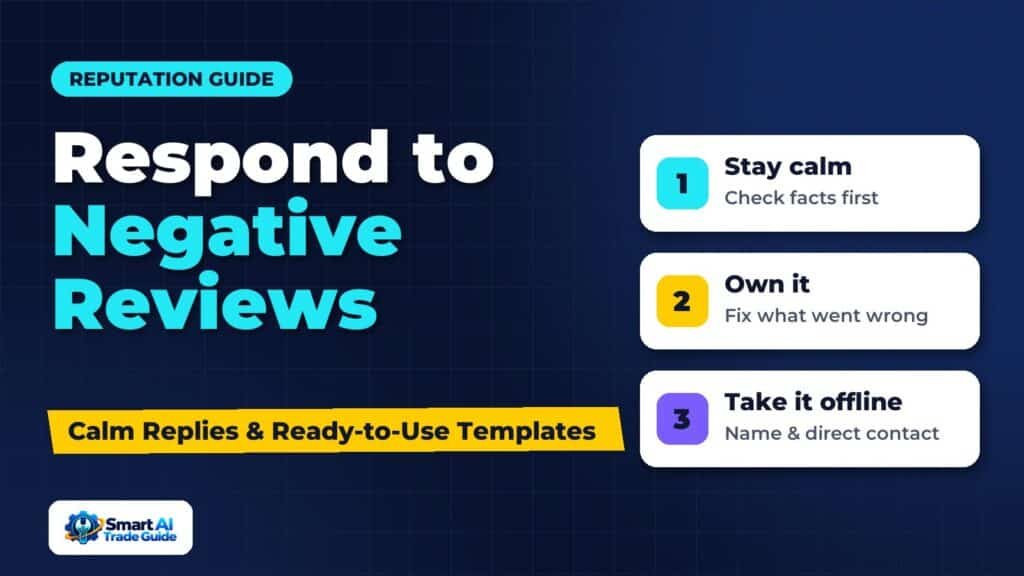
Negative reviews are part of running a trades business. Respond calmly, specifically and briefly, take responsibility where it is due, and move the conversation offline. Never argue, never offer incentives to change reviews and never post fake ones. Then reduce the impact of future negative reviews by collecting genuine positive ones consistently and fixing the problems that cause complaints in the first place.