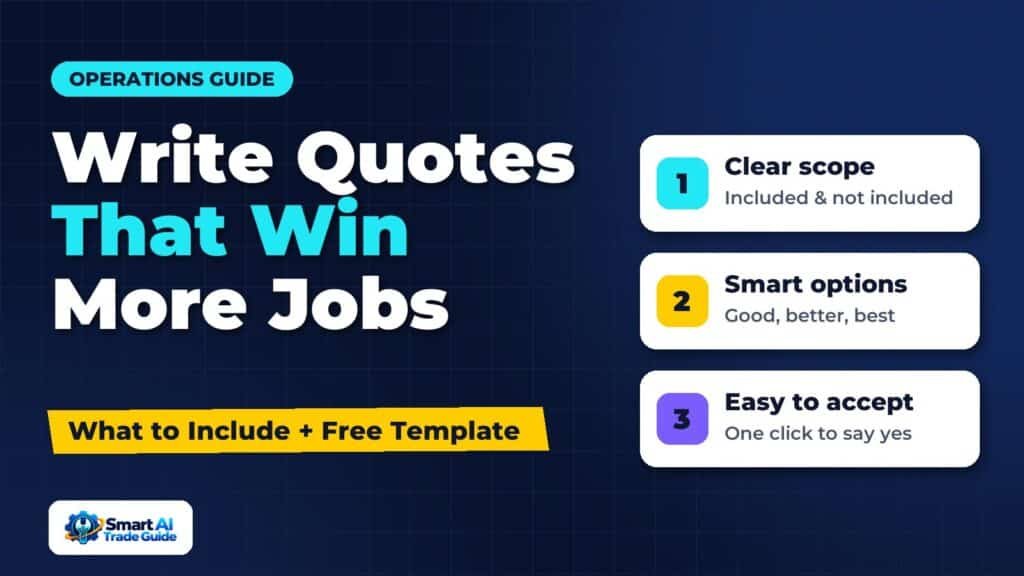
Most trades businesses lose more jobs at the quote stage than they realise. Not because the price was too high, but because the quote was hard to understand, arrived too late, or did not give the customer enough confidence to say yes. A clear, well-structured quote can win work even when it is not the cheapest.
This guide explains how to write a quote for a service job that customers accept, with a template structure you can reuse. For what happens after the quote is sent, see our guide to automating quote follow-up.
Quote vs Estimate: Be Clear Which One You Are Giving
Customers often use the words interchangeably, but there is an important difference:
- A quote is a fixed price for a defined scope of work. If the customer accepts it, that is normally the price they expect to pay, unless the scope changes.
- An estimate is your best guess of the likely cost, which may change once work starts.
Label your document clearly. If parts of the job are uncertain, give a fixed price for the defined work and explain separately how any unknowns will be handled. Our guide to flat-rate pricing vs time and materials covers when each approach fits.
Speed Matters More Than Most People Think
Customers often contact several businesses. The first clear, professional quote sets the benchmark the others are judged against. Where possible:
- Send small-job quotes the same day.
- Send larger quotes within 24 to 48 hours of the visit.
- If a quote will take longer, tell the customer when to expect it.
Templates and price books make speed much easier. Many field service platforms let you build a quote on a tablet before you leave the property.
What a Winning Quote Includes
A strong quote answers every question the customer might have before they have to ask it.
1. Your Business Details and Credentials
Business name, logo, contact details, and any registrations, accreditations or memberships relevant to the work (for example Gas Safe, NICEIC or trade association memberships in the UK). If you show reviews or ratings, make sure they are genuine and current.
2. Customer and Job Details
Customer name, property address, date of the visit, a quote reference number and how long the quote is valid for (30 days is common).
3. A Short Summary of the Problem or Goal
One or two sentences in the customer’s language. For example: “Your current boiler is 17 years old, losing pressure and no longer economical to repair. You would like a reliable replacement before winter.”
This shows you listened, and it reminds the customer why they asked for the quote.
4. A Clear Scope of Work
List what you will do in plain English. Avoid jargon or explain it briefly. A good structure:
- What we will do
- What is included (materials, removal of old equipment, testing, certificates, clean-up)
- What is not included (for example making good plaster, decorating or anything you would treat as extra work)
The “not included” section prevents most disputes.
5. The Price, Broken Down Sensibly
Show the total clearly, including or excluding VAT as appropriate, and make that obvious. A light breakdown helps customers understand the value without inviting them to haggle over every line. For example: equipment, labour and installation, and any optional extras.
6. Options Where It Makes Sense
Offering two or three options often increases acceptance and average job value, because the customer chooses between your options rather than between you and a competitor. For example:
| Option | What it includes | Price |
|---|---|---|
| Essential | Replace boiler like for like, standard controls | £2,450 |
| Recommended | Replacement plus smart thermostat and system flush | £2,890 |
| Premium | Recommended option plus extended warranty and annual service plan | £3,290 |
Keep the options genuinely different and honest. Do not pad a “premium” tier with things the customer does not need.
7. Timescale
When you can start, how long the work will take and anything the customer needs to do beforehand (clear access, move furniture, arrange parking).
8. Payment Terms
Deposit amount and when it is due, when the balance is due, and how customers can pay. Online payment links make this easier. Our guide to reducing no-shows and cancellations explains how deposits also protect your schedule.
9. Guarantees and Warranties
What your workmanship guarantee covers and for how long, plus any manufacturer warranties. Only state what you can stand behind.
10. A Clear Next Step
Tell the customer exactly how to accept: an “Accept quote” button, a reply to the email, or a signature. The easier it is to say yes, the more customers will.
A Simple Quote Template Structure
You can adapt this structure for almost any trade:
- Header: logo, business name, contact details, credentials
- Quote reference, date and validity period
- Customer name and job address
- Summary of the problem or goal
- Scope of work: what we will do, included, not included
- Options (if relevant) with prices
- Total price and VAT status
- Timescale and preparation needed
- Payment terms and accepted payment methods
- Guarantees and warranties
- How to accept, with a link or signature box
- Terms and conditions (short summary, with full terms linked)
How AI Can Help (Without Doing the Pricing)
AI assistants are useful for turning rough site notes into a clear scope of work, or tidying the wording of a quote. Our guide to ChatGPT for contractors includes a prompt for exactly this. Keep pricing, materials and technical decisions in your own hands, and check every line before sending.
Mistakes That Lose Jobs
- One-line quotes. “Supply and fit new boiler: £2,450” tells the customer nothing about why you are worth it.
- Jargon. If the customer cannot understand it, they cannot compare it fairly.
- Hidden extras. Surprise costs later damage trust and reviews.
- No validity date. Prices for materials change; protect yourself.
- Slow delivery. A great quote sent after a competitor’s job has started wins nothing.
- No follow-up. Many customers simply forget. A polite check-in two and seven days later recovers a surprising number of jobs.
Track Your Quote Conversion Rate
Your conversion rate is the percentage of quotes that turn into booked jobs. Track it by job type and by person quoting. If it is low on a particular service, look at price, speed and presentation. If it is very high everywhere, your prices may be too low. Our guide to technician KPIs covers this and other useful measures.
Frequently Asked Questions
Should I charge for quotes?
Many trades offer free quotes for standard work but charge for detailed surveys, design work or diagnosis. If you charge, explain what the customer gets and consider crediting the fee against the job if they go ahead.
How long should a quote be valid for?
Thirty days is common for most domestic work. If material prices are volatile, a shorter period or a clause allowing price changes for materials can protect you.
Should I include a breakdown of labour and materials?
A light breakdown builds trust. A very detailed one can invite customers to source their own parts or negotiate line by line. Aim for clarity, not maximum detail.
Is it better to email or text a quote?
Send it in the format your customer uses most, and ideally both: a short text with a link to a professional quote they can accept online.
Conclusion
A winning quote is fast, clear and easy to say yes to. Summarise the problem, explain exactly what you will do and what is not included, offer sensible options, state the price and terms plainly, and make acceptance a single step. Then follow up. Small improvements to how you write quotes can win more jobs without lowering a single price.