
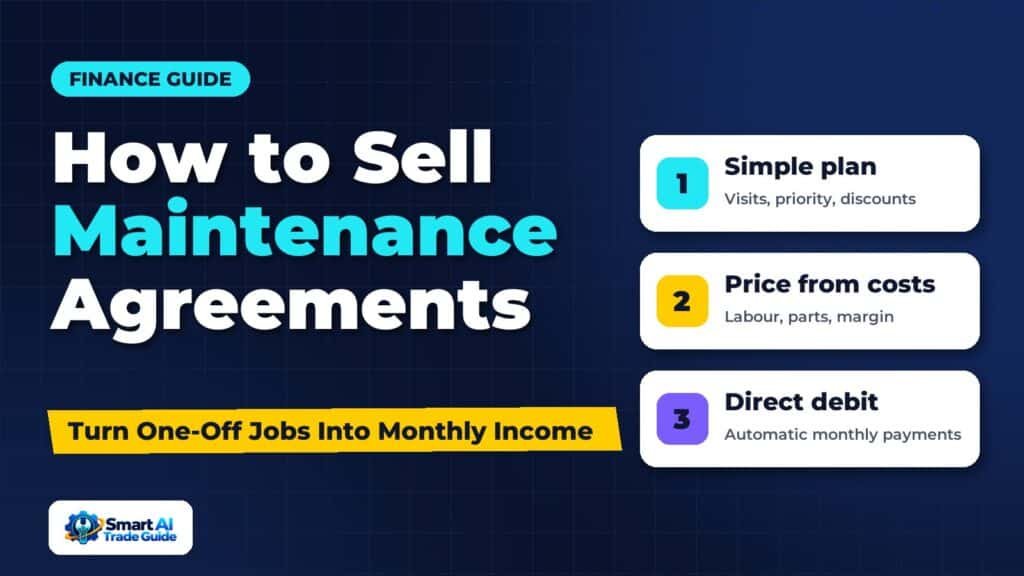
Most service businesses work hard to win a customer, do a good job, send an invoice and then never hear from that customer again until something breaks. A maintenance agreement changes that relationship. The customer pays a small amount each month or year, and in return gets scheduled visits, priority service and peace of mind. You get predictable income and work you can schedule into quieter weeks.
This guide covers how to sell maintenance agreements in practice: what to include, how to price them, when to offer them and how to keep customers signed up.
Why Maintenance Agreements Are Worth the Effort
A good maintenance plan does several jobs at once:
- Predictable revenue. Monthly payments arrive regardless of the weather.
- Schedule control. You choose when routine visits happen, so you can fill quiet periods. This is one of the best tools for handling the winter slow season.
- Higher customer lifetime value. Plan customers stay longer and call you first when something goes wrong. Our guide to customer lifetime value shows how much this is worth.
- More repair and replacement work. Routine visits spot problems early, and plan members are more likely to say yes to recommended work.
- A more valuable business. Recurring revenue is attractive if you ever want to borrow money or sell.
Which Trades Can Offer Them?
Almost any trade where equipment or property needs regular attention:
| Trade | Typical plan |
|---|---|
| Heating and HVAC | Annual boiler or system service, priority call-outs, discounted repairs |
| Plumbing | Annual checks, drain maintenance, water heater service |
| Electrical | Periodic inspections, EV charger checks, commercial testing schedules |
| Landscaping | Seasonal maintenance visits, lawn treatments |
| Cleaning | Recurring cleans with locked-in rates |
| Pest control | Quarterly or monthly treatments and inspections |
| Roofing and gutters | Annual inspections and gutter clearing |
Step 1: Decide What the Plan Includes
Keep the first plan simple. Customers need to understand it in one sentence. A common structure:
- One or two scheduled visits per year (for example, an annual service).
- Priority booking when something goes wrong.
- A discount on repairs, often 10% to 15%.
- No call-out fee for plan members, if you normally charge one.
Avoid promising unlimited free repairs or parts. That is insurance, not maintenance, and it can become very expensive. Be precise about what is and is not included, in writing.
Step 2: Price the Plan Properly
Start with your costs, not with what a competitor charges. For each plan visit, work out:
- Labour time, including travel, at your loaded hourly cost.
- Materials or consumables used on a typical visit.
- The cost of benefits, such as discounts given and call-out fees waived.
- Admin and payment costs, including direct debit fees.
- Your target margin.
Then divide the annual total by 12 to get a monthly figure. For example:
| Item | Annual cost |
|---|---|
| One service visit (1.5 hours including travel at £45/hour loaded cost) | £67.50 |
| Consumables | £10 |
| Estimated value of discounts and waived call-out fees | £20 |
| Payment and admin costs | £8 |
| Total cost | £105.50 |
| Price at a 40% gross margin (£105.50 ÷ 0.6) | £175.83 |
| Monthly price | About £14.65, rounded to £14.99 |
Your numbers will be different, but the method stays the same. Our guide to pricing service jobs covers loaded labour costs in detail.
Many businesses offer two tiers, such as a basic plan (annual service only) and a premium plan (service plus priority response and bigger repair discounts). Two clear options usually sell better than one, and better than four.
Step 3: Make Payment Automatic
The easiest plans to keep are the ones customers never have to think about. Monthly direct debit is the standard in the UK. Services such as GoCardless charge a percentage plus a small fixed fee per payment (for example, around 1% + 20p on UK payments on its standard plan, capped at a few pounds per transaction, at the time of writing). Card subscriptions through tools like Stripe or your field service software are the alternatives.
Whichever you use, check that it:
- Retries failed payments automatically.
- Notifies you when a payment fails, so you can follow up.
- Connects to your accounts or job management software.
Many field service platforms, including Jobber, Housecall Pro and ServiceTitan, can manage recurring plans and schedule the visits for you.
Step 4: Offer the Plan at the Right Moments
The best time to offer a plan is when the customer has just seen the value of your work. Good moments include:
- At the end of a service or repair visit, when the technician has explained what they found.
- On the invoice or job-completion message, with a simple sign-up link.
- When installing new equipment, framed as protecting the investment and supporting the warranty where relevant.
- In a reactivation campaign to past customers before your quiet season.
Technicians are often your best salespeople because customers trust them. Give them a simple script, not a sales pitch. For example: “Most of our customers go on our service plan so they don’t have to remember the annual service, and they get priority if anything goes wrong. It’s £14.99 a month. Would you like me to set that up?”
Some businesses pay a small bonus per plan sold, which keeps it front of mind.
Step 5: Deliver the Visits Reliably
A plan that the customer pays for but never receives is the fastest way to lose them and damage your reputation. Put the visits on the calendar as soon as someone signs up, and send automated reminders before each one.
During the visit, leave evidence of value: a short report with photos, what was checked and anything to watch. If you use AI to turn technician notes into job reports, this takes very little time.
Step 6: Keep Customers Renewing
Plan cancellations usually happen because customers forget what they are paying for. Reduce churn by:
- Sending a brief annual summary of what they received.
- Reminding them of their member discount when they book repairs.
- Calling customers whose payments fail, rather than letting the plan lapse silently.
- Reviewing the plan price annually and explaining any increase clearly.
Common Mistakes to Avoid
- Underpricing to win sign-ups. A plan that loses money on every visit gets worse as it grows.
- Vague terms. Unclear coverage leads to disputes.
- Too many tiers. Choice overload slows decisions.
- Selling plans you cannot deliver. Make sure you have capacity for the visits you are promising.
- Forgetting consumer rules. Give clear terms, cancellation rights and pricing information. If you are unsure, get advice on the consumer protection rules that apply in your country.
Frequently Asked Questions
How many plan customers do I need for it to matter?
Even 50 to 100 members can make a real difference. At £15 a month, 100 members bring in £18,000 a year in predictable income, plus the repair work their visits uncover.
Should plans be monthly or annual?
Monthly payments are easier for most homeowners to accept and smooth your cash flow. Annual upfront payments bring cash forward but are a bigger decision for the customer. Some businesses offer both, with a small discount for paying annually.
What if a customer cancels mid-year after their visit?
Set this out in your terms. Many businesses require a minimum term or a balancing payment if the customer cancels after receiving the annual visit. Keep it fair and clearly explained.
Can small businesses really manage this?
Yes. A spreadsheet and a direct debit provider are enough to start. As the number of members grows, field service software makes scheduling and billing much easier.
Conclusion
Maintenance agreements are one of the most reliable ways to make a service business more stable. Start with one simple plan priced from your real costs, collect payments automatically, offer it at the moments customers already see your value, and deliver every visit you promise. Over a year or two, plan members become the steady base the rest of the business is built on.

1 thought on “How to Sell Maintenance Agreements: A Practical Guide for Service Businesses”
Pingback: Best HVAC Software for Small Business (2026 Guide)