When a customer calls your business, someone needs to answer.
For trades and service businesses, that sounds simple until the phone rings while you are:
- driving;
- working on a job;
- talking to another customer;
- using tools;
- outside normal office hours.
That is why many small businesses use either an AI receptionist or a virtual receptionist.
Both can help answer calls, collect customer details and reduce missed opportunities.
But they work very differently.
An AI receptionist uses conversational software to handle calls automatically.
A virtual receptionist usually involves a real person answering calls remotely on behalf of your business.
For plumbers, electricians, HVAC companies, contractors and other service businesses, the better choice depends on call volume, budget, complexity and how much human interaction your customers expect.
This guide compares AI receptionist vs virtual receptionist services so you can decide which approach better fits your business.
What Is an AI Receptionist?
An AI receptionist is software that answers telephone calls using artificial intelligence.
It can usually greet callers, understand spoken questions and respond based on instructions or business information provided during setup.
Depending on the platform, an AI receptionist may also:
- collect caller information;
- qualify leads;
- answer frequently asked questions;
- schedule appointments;
- transfer calls;
- send text messages;
- create call summaries;
- update a CRM;
- operate outside normal business hours.
The biggest advantage is automation.
Once configured, the AI can potentially answer several calls without requiring a human receptionist to handle each conversation.
What Is a Virtual Receptionist?
A virtual receptionist is generally a remote human receptionist who answers calls for a business.
The receptionist may work for an answering-service company rather than being employed directly by your business.
A virtual receptionist can usually:
- answer calls;
- take messages;
- collect customer details;
- transfer calls;
- book appointments;
- answer common questions;
- follow call-handling scripts.
The key difference is that a real person is speaking with the customer.
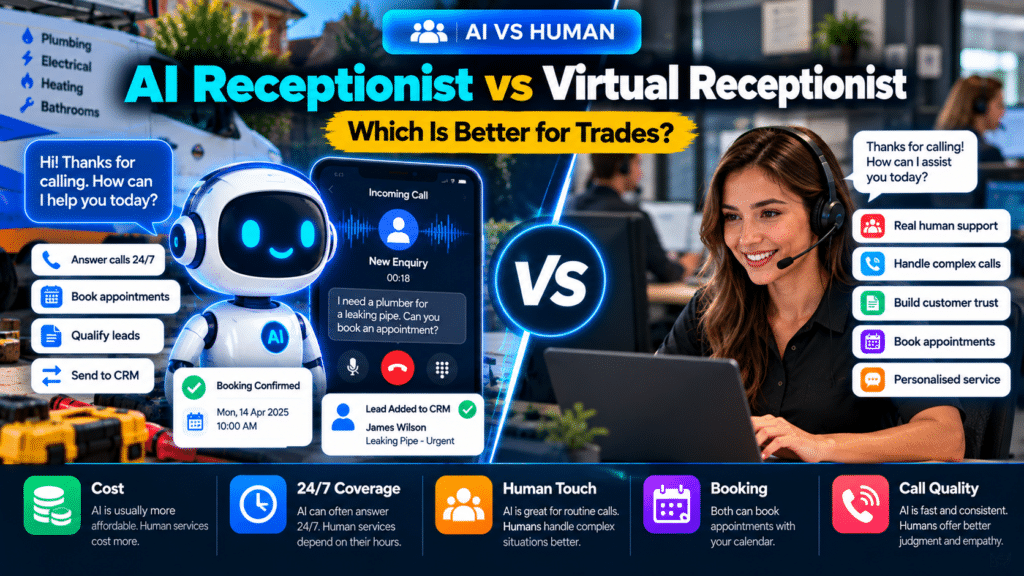
AI Receptionist vs Virtual Receptionist: Quick Comparison
| Feature | AI Receptionist | Virtual Receptionist |
|---|---|---|
| Call handling | Automated | Human |
| 24/7 availability | Often available | Depends on service |
| Cost | Usually lower at scale | Usually higher |
| Natural empathy | Limited | Stronger |
| Speed | Immediate | Depends on staffing |
| Multiple simultaneous calls | Often easier to scale | May depend on team capacity |
| Appointment booking | Common | Common |
| CRM integrations | Often strong | Varies by provider |
| Complex conversations | More limited | Usually better |
| Script consistency | Very consistent | Can vary by person |
| Human judgment | Limited | Stronger |
| Best for | Repetitive, predictable calls | Complex or sensitive calls |
The Main Difference: Automation vs Human Judgment
The biggest difference is straightforward.
An AI receptionist follows a configured system.
A virtual receptionist can apply human judgment.
For example, imagine a customer says:
“I have water coming through the ceiling and I think the boiler might be involved, but I’m not sure.”
An AI receptionist may be able to:
- identify this as urgent;
- collect the address;
- take contact details;
- notify the plumbing company.
A human receptionist may additionally recognize:
- panic in the caller’s voice;
- unusual circumstances;
- when to ask a follow-up question;
- when to interrupt the standard script.
For predictable calls, AI can be efficient.
For unusual calls, humans still have an advantage.
Cost Differences
Cost is one of the strongest reasons businesses consider AI.
AI receptionist services are typically priced around:
- monthly plans;
- call limits;
- minutes;
- usage.
Virtual receptionist services are often priced based on:
- minutes;
- call volume;
- staffing coverage;
- service level.
Because human labor is involved, virtual receptionist services can become more expensive as usage grows.
For a small trades business, this matters.
If most calls are routine, such as:
- “Do you cover my area?”
- “Can I book a quote?”
- “Are you available tomorrow?”
- “What time do you open?”
an AI receptionist may be more cost-effective.
If calls are more complicated, human handling may justify the higher cost.
Availability and After-Hours Coverage
AI receptionists are particularly strong for 24/7 availability.
They do not need:
- breaks;
- shift changes;
- sleep;
- holidays.
That makes them useful for:
- emergency plumbers;
- HVAC companies;
- locksmiths;
- electricians;
- maintenance businesses.
A virtual receptionist can also provide extended-hours or 24/7 coverage, but this usually depends on the provider and plan.
If after-hours coverage is a major priority, compare:
- actual operating hours;
- weekend coverage;
- holiday coverage;
- overnight support.
Call Quality and Natural Conversation
This is where virtual receptionists often have an advantage.
A trained human receptionist can usually handle:
- interruptions;
- accents;
- unclear questions;
- emotional callers;
- unusual requests.
Modern AI can handle increasingly natural conversation, but it may still misunderstand:
- names;
- addresses;
- unusual technical terms;
- unexpected responses.
That does not make AI unusable.
It simply means businesses should test it carefully before sending every call through it.
Lead Qualification
Both AI and virtual receptionists can qualify leads.
For a plumber, the call flow might include:
- What service do you need?
- What is your postcode?
- Is this urgent?
- Are you an existing customer?
- When would you like an appointment?
An AI receptionist can ask these questions consistently.
A human receptionist can adapt if the caller gives unexpected information.
AI Advantage
Consistency.
Every caller can be asked the same important questions.
Human Advantage
Flexibility.
A virtual receptionist can change direction naturally when the conversation requires it.
Appointment Booking
Both options can support appointment scheduling.
An AI receptionist may connect directly with:
- Google Calendar;
- scheduling software;
- field-service software;
- booking systems.
A virtual receptionist may either use your existing calendar or a booking interface provided by the answering-service company.
The key thing to check is whether the receptionist understands:
- technician availability;
- service duration;
- travel time;
- job type.
For trades businesses, scheduling is often more complicated than booking a normal office meeting.
Call Transfers
Some callers should reach a human immediately.
Examples include:
- emergencies;
- complaints;
- high-value commercial leads;
- existing customers with urgent issues.
Both AI and virtual receptionist services can offer call transfers.
However, businesses should test:
- what triggers a transfer;
- who receives it;
- what happens if nobody answers;
- whether voicemail is used as backup.
Call Summaries and CRM Integration
AI receptionists are often particularly strong at creating structured call summaries.
A call summary may include:
- caller name;
- phone number;
- service requested;
- location;
- urgency;
- next action.
Some AI platforms can send this information directly to a CRM.
A virtual receptionist can also create notes, but integration quality varies by provider.
For trades businesses, good CRM integration can remove manual work.
A useful workflow looks like:
Call → Lead Captured → CRM Updated → Staff Notified
Consistency
AI has a strong advantage in consistency.
If you configure the greeting as:
“Thanks for calling ABC Plumbing. How can I help?”
the system should use that greeting every time.
The same qualification questions can be asked consistently.
Human receptionists may vary slightly in tone or wording.
That is not necessarily bad, but it can create inconsistency.
Customer Experience
Customer experience is not just about sounding human.
It is about solving the caller’s problem efficiently.
Some customers may prefer speaking with a person.
Others may care more about:
- getting an immediate answer;
- booking quickly;
- not waiting on hold.
The best system is the one that helps callers complete what they came to do.
AI Receptionist for Plumbers
Plumbing businesses often receive both routine and emergency calls.
AI can work well for:
- lead capture;
- postcode collection;
- booking routine services;
- after-hours coverage;
- call summaries.
A virtual receptionist may be better for:
- anxious customers;
- complicated emergencies;
- unclear problems;
- complaints.
A hybrid model can work well.
For example:
AI handles first response → urgent or complex calls transfer to human
AI Receptionist for Electricians
Electricians may receive enquiries about:
- power failures;
- EV chargers;
- inspections;
- rewiring;
- installations.
AI can collect structured details efficiently.
However, callers describing potential electrical hazards should be routed carefully.
The receptionist should not give technical safety advice unless approved by the business and appropriate for the situation.
AI Receptionist for HVAC Businesses
HVAC companies may experience seasonal call spikes.
AI receptionists can help with:
- appointment requests;
- maintenance calls;
- after-hours leads;
- basic qualification.
Virtual receptionists may provide a better experience when customers are frustrated during extreme weather or urgent breakdowns.
AI Receptionist for Contractors
Contractors often have fewer but higher-value enquiries.
A customer may call about:
- extensions;
- renovations;
- commercial projects;
- remodeling;
- construction estimates.
These calls may require more discussion.
For contractors, a virtual receptionist may sometimes provide more value than a fully automated system.
AI can still be useful for initial lead capture.
Which Is Better for Emergency Calls?
For emergency-related businesses, reliability matters more than novelty.
AI can be effective if the workflow is configured clearly.
For example:
Emergency keyword detected → collect details → alert staff → transfer call
However, if a caller gives unusual information, a human receptionist may handle the situation better.
Emergency workflows should always be tested carefully.
Which Is Better for High Call Volume?
AI generally scales more easily.
If ten customers call at once, an AI-based system may be able to handle several conversations simultaneously.
A human receptionist service depends on staffing capacity.
For businesses with high-volume but repetitive calls, AI can be particularly attractive.
Which Is Better for Complex Calls?
Virtual receptionists usually have the advantage.
Examples include:
- angry customers;
- complicated project enquiries;
- unusual service requests;
- unclear technical problems.
Humans can interpret context more naturally.
Which Is Better for Lead Capture?
Both can work well.
AI can be excellent at structured data collection.
A virtual receptionist may be better at recognizing hidden buying signals.
For example, a caller may casually mention:
“We’re renovating three properties this year.”
A human may recognize that this is a much larger opportunity.
Which Is Better for Small Businesses?
For many small businesses, cost matters heavily.
AI is attractive because it can provide:
- extended coverage;
- lower monthly cost;
- consistent call handling;
- automation.
A virtual receptionist may be better when:
- each lead is high value;
- customer relationships are very personal;
- calls are rarely predictable.
The Hybrid Receptionist Model
The choice does not always need to be AI or human.
A hybrid system can combine both.
For example:
Step 1
AI answers immediately.
Step 2
AI handles routine enquiries.
Step 3
Complex or urgent calls transfer to a person.
This can reduce human receptionist costs while preserving human support where it matters most.
For many service businesses, this may be the most balanced approach.
Questions to Ask Before Choosing a Service
Before subscribing, ask the provider:
Can It Answer 24/7?
Do not assume.
Confirm actual availability.
Can It Book Appointments?
Check which calendar or scheduling tools it supports.
Can It Transfer Calls?
Test the transfer process.
Can It Handle Multiple Calls at Once?
This matters during busy periods.
Does It Integrate With My CRM?
This can save significant admin time.
Can I Customize the Script?
You should control:
- greeting;
- questions;
- services;
- escalation rules.
How Are Calls Charged?
Understand:
- per-minute fees;
- per-call fees;
- monthly limits;
- overages.
Can I Review Transcripts or Recordings?
Call quality should be monitored regularly.
How to Test AI Against a Virtual Receptionist
If possible, run the same test calls through both.
Use realistic scenarios.
Scenario 1: New Lead
“I need a quote for a bathroom renovation.”
Scenario 2: Emergency
“There is water leaking through my ceiling.”
Scenario 3: Existing Customer
“You completed a job yesterday and I need to speak with someone.”
Scenario 4: Complex Question
“I need work at three commercial properties. Who should I speak to?”
Then compare:
- response quality;
- accuracy;
- booking;
- escalation;
- caller experience;
- cost.
Common Mistakes When Choosing a Receptionist Service
Choosing Only on Price
A cheap service that loses valuable leads is not cheap.
Not Testing Call Quality
Always make test calls.
Giving the Receptionist Too Little Information
The system needs accurate:
- services;
- service areas;
- hours;
- escalation rules.
Trying to Automate Complaints
Difficult customer conversations often need humans.
No Backup Process
Decide what happens if:
- the AI fails;
- the transfer fails;
- the receptionist cannot answer.
AI Receptionist vs Virtual Receptionist: Which Should You Choose?
Choose an AI receptionist when your business has:
- predictable calls;
- high call volume;
- a limited budget;
- strong scheduling or CRM integration needs;
- significant after-hours demand.
Choose a virtual receptionist when your business has:
- complex customer conversations;
- high-value leads;
- frequent complaints or unusual enquiries;
- strong preference for human interaction.
Choose a hybrid service when you want:
- AI efficiency;
- human backup;
- lower cost than fully human call handling;
- escalation for complicated situations.
Sources and Further Reading
These official resources back up the methods in this guide and are worth reading alongside it.
- AI receptionist plans and pricing (Smith.ai): current AI receptionist plans.
- Jobber pricing (Jobber): current plans and features.
- Field service management software (Housecall Pro): feature overview.
Related guides
- Best AI Receptionist for Small Business: Trades Edition
- Best Answering Service for Small Business: AI and Human Options
- Best AI Tools for Small Business: 15 Practical Tools to Save Time and Grow
- Tools, Software and Automation for Trades: Start Here
Frequently Asked Questions
What is the difference between an AI receptionist and a virtual receptionist?
An AI receptionist uses conversational software to answer calls automatically, while a virtual receptionist is usually a real person answering remotely for the business.
Is an AI receptionist cheaper than a virtual receptionist?
AI services are often less expensive, particularly at higher call volumes, but pricing varies by provider and usage.
Can an AI receptionist replace a human receptionist?
AI can handle many repetitive tasks, but complex, emotional or unusual calls may still benefit from human involvement.
Can AI receptionists book appointments?
Yes. Many AI receptionist platforms connect with calendars and scheduling tools.
Are virtual receptionists available 24/7?
Some services offer 24/7 coverage, while others operate only during specific hours.
What is better for plumbers: AI or virtual receptionists?
AI can work well for routine enquiries and after-hours call capture. Human receptionists may be better for complicated emergencies or sensitive customer situations.
What is a hybrid receptionist?
A hybrid receptionist service combines AI call handling with the ability to escalate certain calls to a human receptionist.
Conclusion
There is no universal winner in the AI receptionist vs virtual receptionist comparison.
AI receptionists are strongest when the goal is:
- lower cost;
- 24/7 availability;
- consistent call handling;
- scalable automation;
- CRM integration.
Virtual receptionists are strongest when the business needs:
- empathy;
- flexibility;
- human judgment;
- complex conversations.
For many trades and service businesses, the best option may be a hybrid approach.
Let AI handle repetitive calls.
Let people handle the conversations where human judgment matters.
The goal is not to automate the phone simply because AI exists.
The goal is to make sure customers receive a useful response whenever they call.