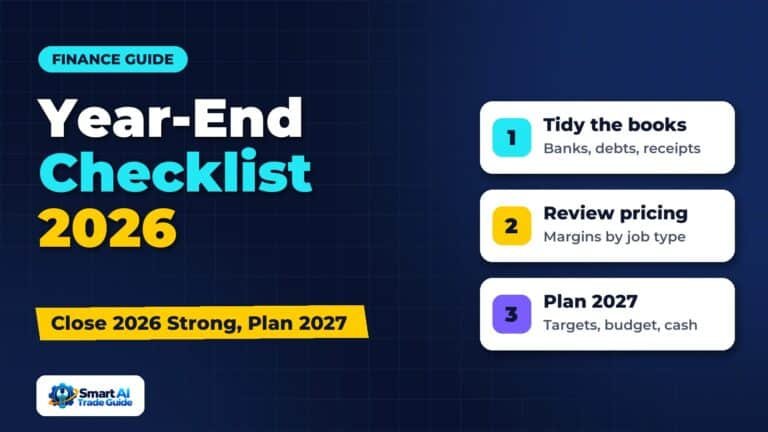
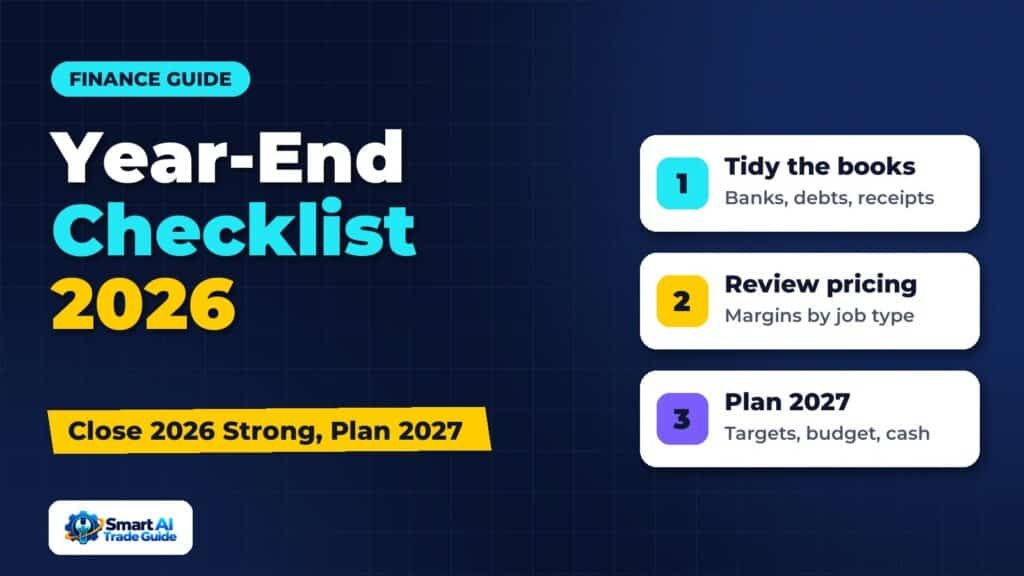
The end of the calendar year is a natural point to step back from the day-to-day. For many trades businesses, December is also a little quieter, which makes it the best chance all year to tidy the books, look honestly at what worked and set up the next twelve months properly.
This year end checklist for service business owners is designed to be worked through over a few weeks in November and December. It is written with UK businesses in mind, with notes for other readers. It is not tax advice; use it alongside your accountant.
Part 1: Tidy the Books
Clean records make every other decision easier, and they make your accountant’s job quicker and cheaper.
- Reconcile your bank accounts in your accounting software up to the end of November, then December as soon as the month closes.
- Chase overdue invoices. Anything over 60 days needs a plan: a call, a payment plan or a decision about writing it off. Our guide to automating invoice reminders helps prevent the backlog next year.
- Match receipts to expenses. Missing receipts for fuel, materials and tools cost money at tax time.
- Check supplier statements against your records so you are not overpaying or missing credits.
- Review subscriptions. Cancel software and services you no longer use.
- Count stock on vans and in storage if you hold significant materials.
Part 2: Understand Your Year in Numbers
Before planning 2027, understand 2026. Pull these numbers for the year (or the last 12 months):
| Measure | Why it matters |
|---|---|
| Total revenue and revenue by service | Shows what really drives the business |
| Gross margin overall and by job type | Shows what is actually profitable |
| Net profit | What you actually kept |
| Revenue per technician | Shows productivity and capacity |
| Average job value | Helps with pricing and marketing decisions |
| New vs repeat customers | Shows how dependent you are on new leads |
| Lead sources and cost per job won | Shows which marketing works |
| Callback rate | Shows quality and hidden costs |
If you do not have these in one place, our guide to building a financial dashboard shows how. Remember the difference between revenue, profit and cash flow: a busy year is not always a profitable one.
Part 3: Review Pricing
Costs rarely stand still. Wages, materials, fuel, insurance and software have all changed during the year. Compare your current prices against your current costs:
- Recalculate your loaded labour cost per hour.
- Update material prices in your price book.
- Check gross margin by job type and identify jobs that are underpriced. See how to calculate gross profit per job.
- Decide on price changes for 2027 and when to introduce them. January is a common and accepted time to update prices.
If you are considering changing your pricing model, our guide to flat-rate pricing vs time and materials covers the trade-offs.
Part 4: Tax and Compliance Dates
Exact obligations depend on your business structure, so confirm with your accountant. Common points for UK trades:
- Self Assessment: for sole traders and partners, the online return and balancing payment for the 2025–26 tax year are due by 31 January 2027, along with any first payment on account for 2026–27.
- Making Tax Digital for Income Tax: from 6 April 2026, sole traders and landlords with qualifying income over £50,000 must keep digital records and send quarterly updates using compatible software. HMRC has announced the threshold will fall to £30,000 from April 2027 and £20,000 from April 2028. If you are close to these thresholds, plan your software now.
- VAT: if you are VAT registered, keep track of your return deadlines. If you are not, monitor your rolling 12-month turnover against the VAT registration threshold (£90,000 at the time of writing).
- Limited companies: your year-end and filing dates depend on your accounting reference date, not the calendar year. Ask your accountant whether there is anything to do before 31 December, such as timing of equipment purchases or dividends.
- Employers: check payroll records, pension contributions and that staff holiday is being tracked correctly.
US readers: check your federal and state deadlines, including contractor information returns (Form 1099) due early in the new year, with your accountant.
Part 5: Protect Cash for the First Quarter
January and February are often slow for many trades, and tax bills can land at the same time. Build a 13-week cash flow forecast covering January to March and check:
- Will Self Assessment or VAT payments create a squeeze?
- Is your cash reserve where it should be?
- Can you bring income forward with deposits on spring work or annual service plan payments?
Part 6: Set Targets and a Budget for 2027
Use this year’s numbers to set realistic targets:
- Revenue target, broken down by month and by service.
- Gross margin target, based on your improved pricing.
- Overhead budget, including any planned hires, vans or software.
- Marketing budget, based on which channels produced profitable jobs. See our guide to marketing ROI.
- Break-even point, so you know the minimum monthly revenue needed. Our break-even guide shows the formula.
Our step-by-step guide to building a monthly budget turns these into a simple plan you can track.
Part 7: People and Capacity
- Hold short reviews with each team member: what went well, what was frustrating, what they want to learn.
- Plan training and certifications for quieter months.
- Decide on hiring. If you were turning away work or running long lead times, read how to know if you can afford another technician.
- Book holiday cover for busy periods early.
Part 8: Systems and Marketing
The quiet weeks are ideal for improvements that are hard to make during busy periods:
- Set up or clean up your job management software and price book.
- Automate the tasks that ate your evenings this year, such as review requests, appointment reminders and quote follow-ups.
- Update your website service pages and Google Business Profile with recent photos and reviews.
- Write down your three most common processes as simple SOPs.
- Review security: passwords, two-factor authentication and backups. Our cybersecurity checklist covers the essentials.
The Year-End Checklist at a Glance
| Area | Key actions |
|---|---|
| Books | Reconcile banks, chase debts, match receipts, check stock |
| Numbers | Revenue, margin, profit, revenue per technician, lead sources |
| Pricing | Recalculate costs, update price book, plan January changes |
| Tax | Self Assessment, MTD readiness, VAT, company year-end, payroll |
| Cash | Q1 forecast, reserve, deposits and plan payments |
| 2027 plan | Targets, budget, marketing spend, break-even |
| People | Reviews, training, hiring decisions, holiday cover |
| Systems | Software, automation, website, SOPs, security |
Frequently Asked Questions
When should I start my year-end review?
Mid-November is ideal. It gives you time to chase debts and make decisions before December gets busy with holidays.
Do I need an accountant for year-end?
For most growing trades businesses, yes. An accountant can make sure you meet deadlines, claim the right allowances and plan tax payments. This checklist helps you arrive prepared, which usually saves time and fees.
Should I raise prices in January?
If your costs have risen and your margins have fallen, January is a common time to adjust prices. Give existing customers notice and explain the change simply.
What is Making Tax Digital for Income Tax?
It is HMRC’s requirement for many sole traders and landlords to keep digital records and send quarterly updates. It applies from April 2026 for qualifying income over £50,000, with lower thresholds planned for later years. Check GOV.UK or ask your accountant whether it applies to you.
Conclusion
A few focused hours at the end of the year can make the next twelve months much easier. Tidy the books, understand your real numbers, fix your pricing, prepare for tax deadlines, protect cash for the first quarter and set clear targets. Then use the quiet weeks to improve the systems and processes that will carry the business through 2027.