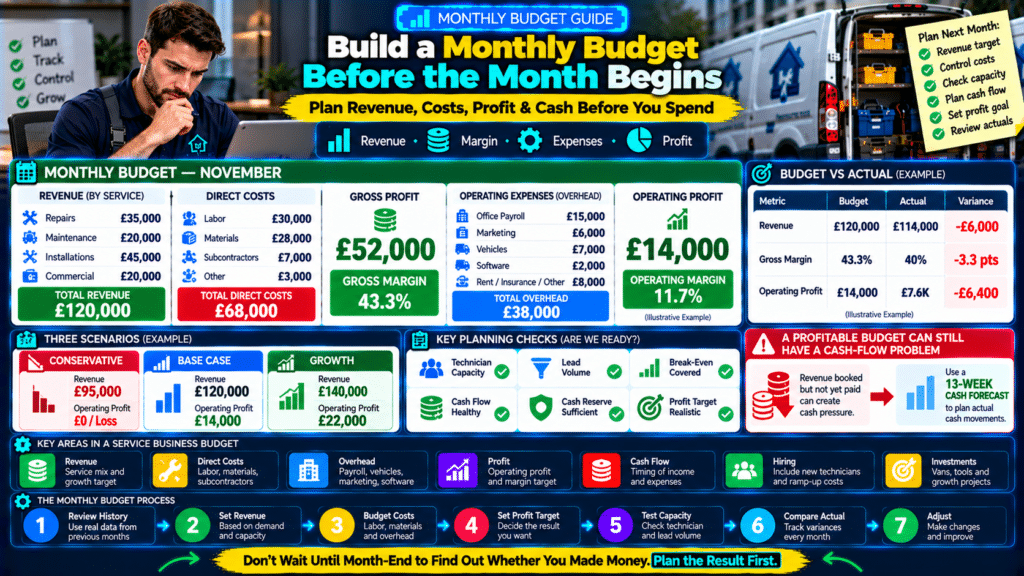
A service business should not wait until the end of the month to discover whether it made money.
By then:
- payroll has already been paid;
- marketing money has already been spent;
- materials have already been purchased;
- vehicles have already consumed fuel;
- discounts have already reduced margins.
A monthly budget helps you decide what should happen before the month begins.
It answers questions such as:
How much revenue do we need?
How much can we afford to spend?
What will payroll cost?
How much gross profit should remain?
What operating profit are we targeting?
A useful monthly budget connects:
Revenue Target
↓
Direct Job Costs
↓
Gross Profit
↓
Operating Expenses
↓
Operating Profit
↓
Cash Requirements
A budget is not about predicting every pound perfectly.
It is about giving the business:
a financial plan before the money is spent.
What Is a Monthly Business Budget?
A monthly budget is a financial plan showing what the company expects to:
- earn;
- spend;
- keep
during a particular month.
For a service business, it may include:
Revenue
- repairs;
- installations;
- maintenance;
- recurring services.
Direct Costs
- technician labor;
- materials;
- subcontractors;
- job-specific expenses.
Operating Expenses
- office payroll;
- vehicles;
- marketing;
- software;
- insurance;
- rent.
Profit
What should remain after those costs.
A simple structure looks like:
Revenue
minus:
Direct Costs
=
Gross Profit
minus:
Overhead
=
Operating Profit
Budget vs Cash Flow Forecast
These are different tools.
Monthly Budget
Answers:
What do we expect the business to earn and spend?
Cash Flow Forecast
Answers:
When will cash actually enter and leave the bank?
You need both.
A budget may show:
£100,000 revenue
for October.
But if customers do not pay until November:
October cash may still be tight.
That is why budgeting and cash-flow forecasting should work together.
Budget vs Break-Even
Break-even tells you:
the minimum revenue required to cover your cost structure.
The budget tells you:
the financial result you are actually targeting.
Example:
Monthly break-even:
£70,000
Budget revenue:
£100,000
Target operating profit:
£12,000
That gives management:
- minimum;
- target.
Step 1: Start With Historical Data
Do not build a budget from imagination.
Review the last:
- 3 months;
- 6 months;
- 12 months.
Look at:
- revenue;
- gross margin;
- payroll;
- materials;
- overhead;
- profit.
Historical performance gives you a realistic starting point.
Example
Last six months revenue:
£82K
£88K
£91K
£86K
£95K
£98K
Average:
approximately:
£90K/month
Planning:
£150K next month
without any major change in:
- technicians;
- demand;
- pricing
would probably be unrealistic.
Step 2: Review Seasonality
Many service businesses are seasonal.
HVAC
Revenue may rise in:
- summer;
- winter.
Landscaping
May be stronger:
- spring;
- summer.
Roofing
Can be affected by:
- weather.
Do not simply divide annual revenue by 12.
Budget each month based on realistic demand.
Example
Annual revenue target:
£1.2 million
Simple average:
£100K/month
But realistic seasonal budget might be:
January:
£90K
February:
£85K
March:
£95K
June:
£130K
July:
£140K
This is much more useful.
Step 3: Set the Revenue Target
Your revenue target should consider:
- historical results;
- current capacity;
- lead volume;
- seasonality;
- pricing;
- growth plans.
Do not use:
I’d like to do £120K.
Build the number.
Capacity-Based Revenue Target
Suppose:
5 technicians.
Healthy monthly revenue per technician:
£22K
Potential field revenue:
£110K
That gives you a practical capacity reference.
If you budget:
£160K
without increasing capacity or pricing:
the plan may not be realistic.
Step 4: Break Revenue Down by Service
Do not keep one giant revenue number.
Example:
Repairs
£30K
Maintenance
£20K
Installations
£40K
Commercial Work
£20K
Total:
£110K
Now you can see:
where the revenue is supposed to come from.
Why Service Mix Matters
Different services have different margins.
Example:
Repairs
Revenue:
£30K
Margin:
55%
Gross profit:
£16.5K
Installations
Revenue:
£40K
Margin:
28%
Gross profit:
£11.2K
Installations generate more revenue.
Repairs generate more gross profit.
Your budget should consider both.
Step 5: Forecast Direct Labor
Estimate technician labor.
Include:
- wages;
- payroll burden;
- direct employment costs
according to your accounting structure.
Example:
Field technician payroll:
£24,000
Employer-related direct costs:
£4,000
Total direct field labor:
£28,000
Use consistent classifications.
Step 6: Forecast Materials
Use your historical material percentage or service-level estimates.
Example:
Installation revenue:
£40K
Expected materials:
£18K
Repair revenue:
£30K
Expected materials:
£6K
Total material budget:
£24K
This is better than guessing one number.
Step 7: Add Subcontractor Costs
If the business regularly uses:
- electricians;
- plumbers;
- plasterers;
- roofers;
- specialist contractors;
include those costs.
Example:
Expected subcontractor spend:
£6,000
Do not wait until invoices arrive to recognize the expense.
Step 8: Calculate Budgeted Gross Profit
Formula:
Revenue − Direct Costs = Gross Profit
Example:
Revenue:
£110,000
Direct labor:
£28,000
Materials:
£24,000
Subcontractors:
£6,000
Other direct costs:
£4,000
Total direct costs:
£62,000
Gross profit:
£48,000
Gross margin:
43.6%
Now ask:
Is that margin healthy enough?
Step 9: Set a Gross Margin Target
Your budget should include a target.
Example:
Current margin:
37%
Target:
40%
Budget:
£110K revenue
At 40%:
Gross profit target:
£44K
This creates accountability.
Step 10: Add Office Payroll
Now include indirect labor such as:
- office staff;
- dispatch;
- admin;
- management.
Example:
Office payroll:
£12,000
Management payroll:
£5,000
Total:
£17,000
These costs come from gross profit.
Step 11: Budget Vehicle Costs
Include:
- finance;
- leases;
- fuel;
- insurance;
- maintenance.
Depending on your accounting system, fuel may be treated differently.
The key is consistency.
Example:
Vehicle budget:
£8,500/month
That should not be a surprise.
Step 12: Budget Marketing
Include:
- Google Ads;
- SEO;
- website;
- social media;
- lead platforms;
- sponsorship.
Example:
Google Ads:
£4,000
SEO:
£1,500
Other marketing:
£1,000
Total:
£6,500
Then connect marketing to:
- leads;
- jobs;
- gross profit.
Marketing Budget Should Have a Purpose
Do not budget:
£5K marketing
simply because:
We spent £5K last month.
Ask:
- What revenue should it support?
- What gross profit should it create?
- Which services are being promoted?
A budget should support strategy.
Step 13: Budget Software
Service businesses often accumulate subscriptions.
Include:
- CRM;
- field service software;
- accounting;
- phones;
- automation;
- email;
- website tools.
Example:
CRM:
£350
Field service:
£500
Accounting:
£100
Phones:
£250
Other:
£300
Total:
£1,500/month
Review unused subscriptions regularly.
Step 14: Add Insurance
Insurance may include:
- business liability;
- vehicles;
- workers / employer coverage;
- property.
Convert annual costs into monthly planning amounts if useful.
Example:
Annual insurance:
£18,000
Monthly planning amount:
£1,500
Even if payment timing differs.
Step 15: Add Rent and Property Costs
Include:
- office rent;
- warehouse;
- storage;
- utilities.
Example:
Rent:
£2,000
Utilities:
£500
Storage:
£700
Total:
£3,200
Step 16: Add Finance and Debt Costs
Include:
- equipment finance;
- vehicle finance;
- loans.
Remember:
cash-flow treatment and profit-and-loss treatment may differ.
For budgeting, follow your accounting structure consistently.
Step 17: Add Professional Fees
Examples:
- accountant;
- bookkeeping;
- legal;
- HR support;
- consultants.
These are often forgotten because they do not happen every week.
Step 18: Add Miscellaneous Overhead
Include a realistic amount for:
- office supplies;
- uniforms;
- training;
- minor repairs;
- bank fees.
Do not create a massive:
“Other”
category that hides everything.
Keep enough detail to make decisions.
Step 19: Calculate Operating Profit
Example:
Gross profit:
£48,000
Operating expenses:
Office payroll:
£17K
Vehicles:
£8.5K
Marketing:
£6.5K
Software:
£1.5K
Insurance:
£1.5K
Property:
£3.2K
Other:
£2.8K
Total overhead:
£41,000
Operating profit:
£7,000
Operating margin:
approximately:
6.4%
Now management can ask:
Is £7K enough?
Step 20: Add a Profit Target
Do not let profit become:
whatever is left.
Set a target.
Suppose desired operating profit:
£15K
Current budget:
£7K
Gap:
£8K
Now you need to decide:
- increase revenue?
- improve gross margin?
- reduce overhead?
This turns budgeting into decision-making.
Target Profit Formula
A simplified planning formula:
Required Gross Profit = Overhead + Profit Target
Example:
Overhead:
£41K
Profit target:
£15K
Required gross profit:
£56K
If gross margin target is:
40%
Required revenue:
£56K ÷ 0.40
=
£140K
Now you can test whether:
£140K is operationally realistic.
Step 21: Check Break-Even Revenue
Suppose overhead:
£41K
Gross margin:
40%
Break-even revenue:
£102,500
If budget revenue is only:
£95K
the plan is below break-even.
That should be visible before the month begins.
Step 22: Check Technician Capacity
Suppose revenue target:
£140K
Technicians:
5
Required revenue per technician:
£28K
Current average:
£21K
That may be unrealistic.
Possible solutions:
- pricing;
- utilization;
- another technician;
- lower profit target.
The budget must agree with operations.
Step 23: Check Lead Requirements
If average booked job value is:
£500
and revenue target:
£140K
Jobs required:
280
If booking rate:
70%
appointments/leads required:
approximately:
400 opportunities
depending on your exact funnel.
Now sales and marketing have a target.
Budget Should Connect Sales and Operations
A strong budget is not only a finance document.
It should connect:
Lead Volume
↓
Jobs Booked
↓
Technician Capacity
↓
Revenue
↓
Gross Profit
↓
Profit
If those numbers do not connect:
the budget may be impossible.
Step 24: Build a Conservative Scenario
Do not create only one budget.
Use:
Base Case
Likely outcome.
Conservative Case
Revenue lower than expected.
Growth Case
Demand stronger.
Example
Base
Revenue:
£110K
Profit:
£7K
Conservative
Revenue:
£90K
Profit:
−£4K
Growth
Revenue:
£130K
Profit:
£15K
Now you understand risk.
Step 25: Stress-Test Revenue
Ask:
What if sales are 15% below budget?
Budget:
£110K
15% lower:
£93.5K
Can the company still:
- cover payroll?
- cover debt?
- remain near break-even?
This shows how resilient the budget is.
Step 26: Stress-Test Gross Margin
Suppose budget margin:
40%
But actual falls to:
35%.
Revenue:
£110K
40%
Gross profit:
£44K
35%
Gross profit:
£38.5K
Difference:
£5.5K
That can wipe out most monthly profit.
Margin risk matters.
Step 27: Budget for Growth Investments Separately
Suppose you plan:
- another van;
- technician hire;
- office expansion.
Show those separately.
Do not hide growth spending inside normal operating expenses.
This makes it easier to understand:
core business profitability
versus:
growth investment.
Example
Normal operating profit:
£12K
New technician ramp cost:
£5K
Van setup:
£4K
Reported short-term result:
£3K
The core business may still be healthy.
Growth costs explain the difference.
Step 28: Compare Budget vs Actual
Budgeting becomes valuable only when you compare:
what you planned
with:
what actually happened.
Example:
| Metric | Budget | Actual | Variance |
|---|---|---|---|
| Revenue | £110K | £102K | -£8K |
| Gross Margin | 40% | 37% | -3 pts |
| Gross Profit | £44K | £37.7K | -£6.3K |
| Marketing | £6K | £7K | +£1K |
| Operating Profit | £10K | £2K | -£8K |
Now investigate:
why.
Budget Variance Is More Important Than Blame
Do not say:
We missed the budget.
Stop.
Ask:
- Was revenue low?
- Was margin weak?
- Did payroll rise?
- Were materials expensive?
- Did callbacks increase?
Variance analysis should lead to action.
Step 29: Create Variance Thresholds
Example:
Green
Within:
±5%
Yellow
5–10% variance.
Red
More than:
10%
Illustrative only.
This helps management focus on large problems.
Step 30: Review Revenue Variance
Budget:
£120K
Actual:
£105K
Variance:
−£15K
Why?
Possible reasons:
- fewer leads;
- lower conversion;
- fewer technicians;
- cancellations.
Identify the real cause.
Step 31: Review Gross Margin Variance
Budget:
42%
Actual:
35%
Possible causes:
- labor overruns;
- discounts;
- materials;
- callbacks.
This is often more important than revenue variance.
Step 32: Review Payroll Variance
Budget:
£30K
Actual:
£36K
Why?
- overtime?
- new hire?
- bonus?
- staffing error?
Payroll should be understood, not simply accepted.
Step 33: Review Marketing Variance
Budget:
£5K
Actual:
£8K
Maybe marketing overspent.
Or maybe additional spend produced:
£30K profitable revenue.
Variance is not automatically bad.
The result matters.
Favorable vs Unfavorable Variance
Spending less is not always:
good.
Example:
Training budget:
£2K
Actual:
£0
Favorable variance?
Financially, yes.
Operationally, maybe not.
Perhaps training was necessary to reduce callbacks.
Use judgment.
Step 34: Create a Weekly Budget Pulse
You do not need to wait until month-end.
Each week track:
Revenue vs Budget
Gross Margin
Payroll
Marketing
Major Expenses
Example:
Monthly revenue target:
£120K
Week 1 target:
£30K
Actual:
£24K
Now you know early that the month may be behind.
Do Not Divide Monthly Revenue Equally if Business Is Uneven
Some weeks naturally differ.
Use historical patterns.
Example:
Week 1:
20%
Week 2:
25%
Week 3:
25%
Week 4:
30%
Your weekly budget can reflect reality.
Step 35: Run a Monthly Budget Meeting
A useful meeting can answer:
- What did we budget?
- What actually happened?
- What were the biggest variances?
- Why?
- What changes next month?
Keep it practical.
Monthly Budget Dashboard
Track:
Revenue Budget: £120K
Revenue Actual: £114K
Gross Margin Budget: 42%
Actual: 40%
Operating Expense Budget: £38K
Actual: £39K
Profit Target: £12K
Actual: £6.6K
This creates visibility.
Connect Budget to Cash Flow
Your budget may show profit.
But then check:
When will customer payments arrive?
Feed the budget into your:
13-week cash flow forecast.
This tells you whether the plan can also be funded.
Example
Budget:
£120K revenue
£12K profit
Sounds good.
But:
commercial customers pay after:
60 days.
Cash may still fall below safe levels.
Profit planning and cash planning must work together.
Connect Budget to Cash Reserve
If your budget expects:
temporary negative cash flow
ask:
Will we need the reserve?
If yes:
plan it intentionally.
Do not discover it after cash disappears.
Connect Budget to Hiring
Suppose next month includes:
new technician.
Add:
- wages;
- vehicle;
- tools;
- ramp-up.
Then update:
- revenue capacity;
- cash forecast.
Hiring should exist inside the budget.
Connect Budget to Marketing
Suppose new technician creates:
£25K monthly capacity.
But there are not enough leads.
Marketing may need to increase.
Now the budget connects:
new technician + additional marketing + additional revenue.
That is strategic planning.
Build an Annual Budget From Monthly Budgets
Once monthly budgets exist:
combine them.
This shows:
- seasonal revenue;
- annual payroll;
- annual profit target.
Annual planning becomes much more useful than:
annual revenue ÷ 12.
Example Annual View
Q1:
£280K
Q2:
£330K
Q3:
£390K
Q4:
£300K
Annual revenue:
£1.3M
Now you can plan:
- hiring;
- vans;
- marketing
around expected seasonality.
Use a Rolling Forecast
A static annual budget gets old quickly.
A rolling forecast updates future months as new information appears.
For example:
October ends.
Add:
next October
to the 12-month forecast.
Now you always have:
12 months ahead.
This is useful for growing businesses.
Common Budgeting Mistakes
Using Revenue Only
Profitability disappears.
Ignoring Gross Margin
Sales can grow while profit falls.
Unrealistic Revenue Targets
Capacity may not support them.
Forgetting One-Time Expenses
Van purchases surprise cash flow.
No Seasonal Adjustment
Every month is not identical.
Ignoring Technician Capacity
Finance plan becomes operationally impossible.
No Budget vs Actual
Budget becomes useless.
No Cash Forecast
Profitable budget can still create liquidity problems.
Cutting Everything
Some expenses drive growth and quality.
Never Updating the Budget
Business changes.
Simple Monthly Budget Example
Revenue
Repairs:
£35K
Maintenance:
£20K
Installations:
£45K
Commercial:
£20K
Total Revenue: £120K
Direct Costs
Labor:
£30K
Materials:
£28K
Subcontractors:
£7K
Other:
£3K
Total Direct Costs: £68K
Gross Profit
£52K
Gross margin:
43.3%
Operating Expenses
Office Payroll:
£15K
Marketing:
£6K
Vehicles:
£7K
Software:
£2K
Rent / Storage:
£3K
Insurance:
£2K
Professional / Other:
£3K
Total Overhead: £38K
Operating Profit
£14K
Operating margin:
11.7%
Now the business has a clear plan.
Monthly Budget Checklist
Before the month starts, confirm:
- Revenue target set
- Revenue split by service
- Technician capacity checked
- Direct labor budgeted
- Material costs budgeted
- Subcontractors included
- Gross margin target set
- Office payroll included
- Vehicle costs included
- Marketing included
- Software included
- Insurance included
- Property costs included
- Debt / finance included
- Profit target set
- Break-even checked
- Cash flow tested
- Growth expenses separated
- Conservative scenario prepared
- Budget-vs-actual review scheduled
Sources and Further Reading
These official resources back up the methods in this guide and are worth reading alongside it.
- Manage your finances (U.S. Small Business Administration): bookkeeping, financial statements and cash flow basics.
- Write your business plan (U.S. Small Business Administration): building financial projections.
- Break-even point (U.S. Small Business Administration): break-even formulas and a free calculator.
Related guides
- How Much Cash Reserve Should a Service Business Keep?
- How to Price Service Jobs Without Guessing: Labor, Materials, Overhead & Profit
- Tools, Software and Automation for Trades: Start Here
Frequently Asked Questions
How do you create a monthly budget for a service business?
Start with:
- expected revenue;
- direct costs;
- gross profit;
- operating expenses;
- profit target.
Then compare the plan with:
- technician capacity;
- cash flow.
How much should a service business budget for expenses?
There is no universal percentage.
Costs depend on:
- trade;
- payroll;
- vehicles;
- service mix;
- marketing.
Use your historical data and margin targets.
Should payroll be included in the budget?
Yes.
Separate:
- direct technician labor;
- office / management payroll
according to your accounting structure.
Should materials be budgeted as a percentage of revenue?
They can be estimated that way initially, but service-level historical data is usually better.
What is budget vs actual?
It compares:
planned financial results
with:
what actually happened.
The difference is called:
variance.
Should a monthly budget include profit?
Yes.
Do not treat profit as:
whatever remains.
Set a target.
Is a budget the same as a cash flow forecast?
No.
A budget plans financial performance.
Cash forecasting plans:
timing of actual cash.
Should a service business budget monthly or annually?
Ideally both.
Build monthly budgets and combine them into an annual plan.
How often should the budget be reviewed?
Weekly high-level review and monthly detailed review works well for many businesses.
What if actual results are very different from budget?
Investigate the cause.
Then adjust:
- operations;
- pricing;
- spending;
- future forecasts.
Conclusion
Learning how to build a monthly budget for a service business gives owners a financial plan before the month begins.
A strong budget connects:
Revenue
↓
Direct Costs
↓
Gross Margin
↓
Overhead
↓
Profit
But it should also connect those financial numbers to:
Technician Capacity
Lead Volume
Cash Flow
Hiring
Marketing
For example:
Revenue target:
£120K
Gross margin:
43.3%
Gross profit:
£52K
Overhead:
£38K
Operating profit:
£14K
Now the owner can ask:
Can our technicians realistically produce £120K?
Do we have enough leads?
Will the cash arrive when payroll is due?
Is £14K profit enough for our goals?
That is what makes a budget useful.
Do not create it once and put it in a spreadsheet nobody opens.
Every month:
Plan
↓
Track
↓
Compare
↓
Investigate Variance
↓
Adjust
A monthly budget turns business finance from:
“Let’s see what happens.”
into:
“Here is what we are trying to achieve, and here is how we will measure it.”
That is a much stronger way to grow a service business.